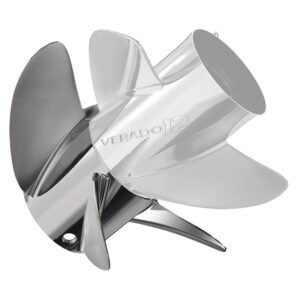
Verado12 (27.5″) MERCURY LH 4-Blade Front Propeller 48-8M0166985
€1,060.00Verado12 (27.5″) MERCURY LH 4 Blade Front Propeller 48-8M0166985 The Verado12 (27.5″) MERCURY LH 4-Blade Front Propeller 48-8M0166985 exists for operators who demand elevated rig behavior, measurable on-water efficiency, and consistent control across changing conditions. When vessels push into higher RPM ranges, prop selection determines whether a boat performs at peak efficiency or sacrifices thrust to turbulence, drag, and slip. Because propulsion is the bridge between mechanical output and hydrodynamic reality, every aspect of the design affects acceleration, lift, steering weight, and stability.MERCURY LH 4 Blade Front Propeller Operators often seek more than a part number or singular upgrade. Instead, they look for a performance intervention—a way to reclaim throttle authority, expand usable trim angles, and optimize real torque delivery rather than theoretical horsepower. Consequently, this propeller exists at the intersection of practical improvement and engineered precision.MERCURY LH 4 Blade Front Propeller Although many aftermarket solutions appear comparable on paper, few deliver meaningful steering discipline, low-slip launch control, and multi-speed consistency simultaneously. This propeller is designed to provide all three.MERCURY LH 4 Blade Front Propeller From Real-World Handling to Performance Reliability Many operators report specific problems before upgrading. Importantly, these issues are not abstract—they appear during routine use: Bow rise that lingers too long during hole-shot Trim angles that feel “usable but narrow” Steering that demands too much correction in quartering seas Ventilation during hard trim applications RPM fluctuation under mid-range acceleration Loss of bite in confused water or heavy traffic wake The Verado12 (27.5″) MERCURY LH 4-Blade Front Propeller 48-8M0166985 targets these friction points directly. Moreover, it does so without requiring disruptive modification to the vessel’s running gear. Instead, performance is added through geometry, pitch accuracy, and blade engagement efficiency.MERCURY LH 4 Blade Front Propeller Geometry, Pitch & Traction Fundamentals Hydrodynamic Leverage Begins With Blade Interaction Although horsepower initiates motion, blade geometry converts that force into progress. Unlike 3-blade alternatives that often struggle under heavier load conditions, the 4-blade front configuration produces a cleaner torque curve. Because of this, acceleration improves without requiring additional fuel or calibration changes.MERCURY LH 4 Blade Front Propeller Pitch Stability at 27.5″ The 27.5-inch pitch was selected to achieve an equilibrium between thrust authority and efficient RPM utilization. Higher pitch can feel faster on flat water, yet it often causes drag penalties when correcting course or navigating wake. Lower pitch may launch aggressively, but it sacrifices momentum and trim stability. This configuration achieves middle-band control that supports: Heavier loads without bogging Superior bite during throttle adjustments Consistent acceleration curves True hydrodynamic discipline at speed Consequently, the user experiences forward motion that feels unified rather than fragmented. Design Intent for System Compatibility Because many Verado owners invest in premium propulsion, they expect upgrades that respect factory tolerances. This propeller supports that expectation by aligning mass balance, rake, and pitch precision in a way that integrates with Mercury Verado systems rather than working against them.MERCURY LH 4 Blade Front Propeller Functional Purpose, Not Ornamental Hardware One theme remains central: this propeller is not decorative performance. Instead, it is functional performance that translates into measurable behavioral change on the water. Turning radiuses tighten. Ventilation drops. Trim angles become useful through a broader band. The vessel behaves as though its center of gravity is cooperating with its propulsion rather than fighting it.MERCURY LH 4 Blade Front Propeller 1. Lift & Throttle Integrity Vessels remain on plane more naturally, which supports stability in variable water states. Acceleration becomes a progression rather than a negotiation.Verado12 2. Directional Confidence Steering inputs feel proportional to output, giving operators a sense of conversational control rather than reactive correction. 3. Efficiency Gains Without Engine Changes Performance increases exist as a product of design, not fuel consumption. No tuning, re-mapping, or aftermarket calibration becomes mandatory. How Engineering Choices Convert to Real Handling Improvements The Verado12 (27.5″) MERCURY LH 4-Blade Front Propeller 48-8M0166985 does more than spin water into thrust. It reorganizes pressure loads, water adhesion characteristics, slip control, and steering leverage to ensure that force applied by the drive becomes consistent acceleration rather than reactive resistance. Because the 4-blade geometry maintains cleaner contact with water, especially during transitions between trim angles, thrust integrity remains intact even when ambient conditions shift.MERCURY LH 4 Blade Front Propeller Although some propellers behave competitively at either low or high speed, this configuration performs through the entire acceleration curve. Therefore, operators maintain control instead of constantly adapting to the propeller’s behavior.MERCURY LH 4 Blade Front Propeller Blade Area & Fluid Management More blade surface means more water management per revolution. Yet, too much surface area increases drag; too little sacrifices lift. This configuration lands in a critical equilibrium zone. It captures, channels, and redirects water without overloading engine output. Rake & Cup Geometry for Hydrodynamic Authority Rake refers to the angle of the blade relative to the hub. Cup refers to curvature at the trailing edge. When calibrated correctly: Bow lift increases through controlled rake leverage Water adhesion remains predictable during trim input Thrust channels forward rather than dispersing laterally Steering load becomes more proportional and less fatigued Consequently, the vessel lifts sooner, planes faster, and tracks straighter. Predictable RPM Range Under Load Acceleration depends on how the propeller handles early torque application. Rather than surging into RPM jumps, this propeller translates increasing throttle into a progressive and predictable curve. Because of cleaner water management, RPM pulses diminish and throttle changes behave more linearly.MERCURY LH 4 Blade Front Propeller Mid-Range Efficiency Mid-range efficiency is where most operators spend their time. Speed, fuel economy, comfort, and steering discipline intersect here. With this configuration, the mid-band supports:MERCURY LH 4 Blade Front Propeller Stronger hold during moderate chop Deeper usable trim before ventilation Safer cornering in loaded conditions RPM consistency without chasing throttle These behaviors convert into something boaters instantly feel: confidence. Verado12 Recognizing the Difference Cavitation is micro-bubble formation from pressure imbalance. Ventilation is atmospheric air slipping into the prop path. Both destroy thrust efficiency. Why This Propeller Reduces Both Because of its shape and pitch stability, water attaches to the…