


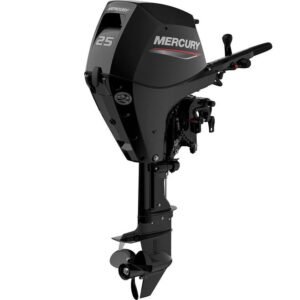
Mercury 2.5hp Tiller FourStroke Outboard Motor – 15″ Shaft, Manual Tilt/Trim, Manual Start
€532.00
Mercury® portable outboard motors are small in size and big on dependability, with plenty of power to handle small jon boats, tender boats, small inflatables and small aluminum boats. They feature a lightweight, compact design for convenient transport, an on-engine fuel tank and a quick-clamp transom bracket for easy installs. From remote waters to your local lake, these rugged little outboards are ready to handle all your adventure needs.
- Easy-to-use tiller handle
- Lightweight, compact portable design
- Quick-clamp transom bracket
- Integrated on-engine fuel tank
- Easy-pull manual starting
- Built with saltwater-safe components and corrosion-preventive technologies
- Outstanding power and fuel efficiency
- Easy oil change system keeps maintenance clean and easy
NOTE: When you unpack your engine, please follow the “Engine Break-In Procedure,” which is outlined inside your engine operation and maintenance manual. First, look over your engine before starting. Then, fill it with engine oil, and check its gear lube level. Next, ensure the propeller is included and secure. Lastly, be sure to review your Mercury Marine Limited Warranty, and your Customer Delivery Inspection (CDI) process should be logged on Mercurymarine.com. Failure to comply with the engine break-in procedure can result in severe engine damage not covered by Mercury Marine Limited Warranty.
Specifications
| Horsepower | 2.5 |
| Starting Type | Manual |
| Steering Type | Tiller |
| Shaft Length | 15″ |
| Model Number | 1F02201KK |
| Trim/Tilt | Manual |
| Fuel Tank Included | Yes |
| Fuel Tank Capacity | .3 gal. |
| Propeller Included | Yes |
| Engine Type | 1-Cylinder |
| Engine Weight | 41 lbs. |
| Recommended Fuel | 87 Octane (Up to 10% Ethanol) |
| Recommended Oil | 10W-30 |
| Pursuit | Recreational Boating |
Description
Mercury 2.5hp Tiller FourStroke Outboard Motor – Precision Power for Confident Boating
Reliable propulsion matters when every journey on the water counts. Whether navigating calm inland lakes, maneuvering through narrow channels, or powering a compact fishing vessel, boaters need an outboard motor that performs consistently while remaining easy to operate. For that reason, the Mercury 2.5hp Tiller FourStroke Outboard Motor – 15″ Shaft, Manual Tilt/Trim, Manual Start stands as a trusted solution for individuals and families who value efficiency, durability, and control.
Rather than focusing on excessive horsepower, this motor prioritizes balance. Power delivery remains smooth, handling feels intuitive, and long-term ownership benefits continue to add value over time. Consequently, the motor appeals to both first-time buyers and experienced boaters seeking a dependable auxiliary engine.
Mercury Marine: A Legacy of Innovation and Trust
Mercury Marine has built its reputation by engineering marine propulsion systems that adapt to real-world boating demands. Over decades, the brand has refined its design philosophy, placing usability, reliability, and environmental responsibility at the forefront.
Engineering Excellence That Supports Every Boater
Mercury Marine designs products with inclusivity in mind. From weekend anglers to professional guides, the company ensures its engines support diverse boating lifestyles. As a result, the Mercury 2.5hp Tiller FourStroke Outboard Motor fits seamlessly into a wide range of use cases.
Key principles guide Mercury’s engineering approach:
-
Precision manufacturing for consistent performance
-
User-friendly controls that reduce fatigue
-
Compact designs that simplify transport and storage
-
Long-term durability for cost-effective ownership
Because these principles shape every model, boaters gain confidence from the moment the engine touches the water.
Product Overview: Compact Power with Purpose
The Mercury 2.5hp Tiller FourStroke Outboard Motor – 15″ Shaft, Manual Tilt/Trim, Manual Start delivers dependable propulsion in a lightweight, easy-to-handle package. Designed specifically for small boats, inflatables, tenders, and jon boats, this motor excels where maneuverability and simplicity matter most.
Instead of overwhelming users with complexity, Mercury focuses on intuitive operation. Therefore, owners spend more time enjoying the water and less time managing equipment.
Core Identity of the Mercury 2.5hp Outboard
This outboard motor represents a strategic balance between power and practicality. While horsepower remains modest, performance efficiency compensates through smooth acceleration and precise control.
The motor’s identity centers on:
-
Efficient four-stroke technology
-
Manual systems that enhance reliability
-
A lightweight profile for portability
-
Quiet operation suitable for fishing environments
Together, these attributes create a motor that supports confidence, even for those new to boating.
Why Four-Stroke Technology Matters
Four-stroke engines have become the preferred choice for modern boaters due to their operational advantages. Compared to older two-stroke designs, four-stroke engines offer improved fuel efficiency, reduced emissions, and quieter operation.
Benefits of the Four-Stroke Design
The Mercury 2.5hp Tiller FourStroke Outboard Motor benefits directly from this advanced engineering approach. As fuel burns more efficiently, users experience extended run times without sacrificing power.
Notable advantages include:
-
Cleaner exhaust output for environmentally conscious boating
-
Reduced vibration for smoother rides
-
Lower operating noise for enhanced comfort
-
Improved longevity through refined combustion cycles
Because of these benefits, four-stroke engines align well with evolving environmental regulations and user expectations.
Compact Design with Practical Impact
Size and weight matter significantly when handling small boats or transporting equipment. Mercury addresses this need by designing a motor that remains compact without compromising build quality.
Lightweight Construction for Easy Handling
The Mercury 2.5hp outboard allows users of varying physical strengths to manage installation and removal comfortably. Consequently, solo boaters and families alike benefit from the motor’s manageable weight.
Key design considerations include:
-
Balanced weight distribution
-
Ergonomic carry points
-
Simplified mounting process
-
Minimal storage footprint
As a result, the motor integrates smoothly into everyday boating routines.
15″ Shaft Configuration: Optimized for Shallow and Standard Transoms
Selecting the correct shaft length ensures optimal performance and protects the motor from unnecessary strain. The 15-inch shaft on this Mercury outboard suits standard transom heights commonly found on small boats and inflatables.
Why Shaft Length Impacts Performance
Proper shaft alignment improves thrust efficiency while reducing cavitation. Therefore, the 15″ shaft allows the propeller to remain positioned correctly in the water, even in variable conditions.
Advantages of the 15″ shaft include:
-
Improved propulsion efficiency
-
Better handling in shallow water
-
Reduced drag during operation
-
Enhanced safety for smaller vessels
Because of these benefits, the motor performs reliably across diverse boating environments.
Manual Tilt and Trim: Control Simplified
Rather than relying on complex electronic systems, Mercury equips this model with manual tilt and trim functionality. This design choice enhances reliability while empowering users with direct control.
Practical Advantages of Manual Systems
Manual tilt and trim allow boaters to adjust the motor angle quickly. As conditions change, users can respond immediately without worrying about electrical failures.
Highlighted benefits include:
-
Simple adjustment for shallow water navigation
-
Reduced maintenance requirements
-
Increased durability over time
-
Greater confidence in remote locations
By focusing on mechanical reliability, Mercury ensures dependable performance wherever boating adventures lead.
Manual Start: Dependable and Accessible
The manual start system reinforces the motor’s simplicity and reliability. Instead of depending on batteries or electrical components, users can start the engine quickly and consistently.
Why Manual Start Appeals to Many Boaters
Manual starting systems remain popular because they function reliably across varied conditions. Consequently, boaters gain peace of mind, especially when operating in remote or off-grid locations.
Key advantages include:
-
No battery dependency
-
Reduced system complexity
-
Lower overall maintenance costs
-
Immediate readiness after storage
Through this approach, Mercury supports inclusive access to boating for users with different experience levels.
Highlighted Product Listing: At-a-Glance Benefits
Mercury 2.5hp Tiller FourStroke Outboard Motor – Key Features
-
Compact four-stroke engine optimized for efficiency
-
15″ shaft ideal for small boats and inflatables
-
Manual tilt and trim for responsive control
-
Manual start for dependable operation
-
Lightweight construction for easy handling
-
Quiet performance suitable for fishing environments
-
Mercury Marine engineering for long-term reliability
This concise overview supports fast decision-making while reinforcing the motor’s value proposition.
Designed for Versatile Applications
The Mercury 2.5hp outboard adapts effectively to multiple boating scenarios. Instead of limiting usage, the motor supports a wide range of activities.
Common Use Cases
Boaters choose this motor for its adaptability and ease of use. Typical applications include:
-
Small fishing boats on lakes and ponds
-
Inflatable tenders for larger vessels
-
Jon boats used in calm waterways
-
Emergency auxiliary propulsion
Because of its versatility, the motor appeals to a broad and inclusive audience.
Ownership Experience: Confidence from Day One
Owning the Mercury 2.5hp Tiller FourStroke Outboard Motor – 15″ Shaft, Manual Tilt/Trim, Manual Start provides more than basic propulsion. The experience extends into maintenance simplicity, fuel efficiency, and long-term satisfaction.
What Owners Appreciate Most
Feedback often highlights the motor’s consistency and ease of operation. As a result, owners feel confident recommending it to others.
Frequently praised aspects include:
-
Predictable starting behavior
-
Minimal learning curve
-
Smooth throttle response
-
Reliable performance over time
Through thoughtful engineering, Mercury ensures each outing begins with confidence.
Technical Specifications and Engineering Advantages
Understanding the technical foundation of an outboard motor enables buyers to make informed, confident decisions. Rather than presenting isolated numbers, this section explains how each specification translates into real-world benefits. Through this approach, the Mercury 2.5hp Tiller FourStroke Outboard Motor – 15″ Shaft, Manual Tilt/Trim, Manual Start demonstrates measurable value for diverse boating needs.
Engine Architecture: Small Displacement, High Efficiency
At the core of this outboard motor lies a purpose-built four-stroke engine engineered for efficiency and longevity. Instead of prioritizing raw output, Mercury focuses on refined power delivery and operational stability.
Precision-Built Single-Cylinder Design
The single-cylinder configuration reduces mechanical complexity while supporting consistent combustion. As a result, vibration remains minimal and power delivery feels smooth throughout the throttle range.
Key engineering outcomes include:
-
Fewer moving components for enhanced reliability
-
Reduced internal friction for longer service life
-
Predictable torque output at low RPM
-
Efficient fuel utilization under steady loads
Because of these factors, the motor maintains performance without unnecessary strain.
Horsepower Rating: Why 2.5hp Is Purposeful
Horsepower selection plays a critical role in matching a motor to its intended vessel. Rather than oversizing the engine, Mercury calibrates the 2.5hp output to meet the demands of lightweight boats and tenders.
Balanced Power-to-Weight Ratio
The 2.5hp rating ensures sufficient thrust for small watercraft without adding excessive mass. Consequently, handling remains responsive while fuel consumption stays low.
Performance advantages include:
-
Confident maneuvering at low speeds
-
Smooth acceleration without abrupt surges
-
Reduced stress on transoms
-
Stable control in calm to moderately variable conditions
Through this balance, the motor supports efficient propulsion for everyday boating.
Fuel System Efficiency and Operational Economy
Fuel efficiency influences both operating costs and environmental impact. Mercury integrates fuel system components that promote clean combustion and consistent delivery.
Optimized Fuel Flow Management
By regulating fuel intake precisely, the engine maintains stable performance across varying throttle positions. Therefore, users experience predictable operation without frequent adjustments.
Fuel system benefits include:
-
Extended run times per tank
-
Lower overall fuel consumption
-
Reduced exhaust emissions
-
Consistent throttle response
As a result, owners enjoy economical operation across repeated outings.
Cooling System Design: Thermal Stability in All Conditions
Effective thermal management preserves engine integrity. Mercury employs a water-cooled system that maintains optimal operating temperatures.
Why Water Cooling Enhances Longevity
Water cooling dissipates heat efficiently, even during extended low-speed operation. Consequently, internal components remain protected from thermal stress.
Key cooling advantages include:
-
Stable engine temperatures during long runs
-
Reduced wear on critical components
-
Improved combustion efficiency
-
Enhanced reliability in warmer climates
Through controlled temperature regulation, the motor sustains consistent performance.
Gearcase and Propulsion Engineering
The gearcase design directly influences thrust efficiency and handling precision. Mercury engineers this component to maximize power transfer while minimizing drag.
Optimized Gear Ratios for Smooth Control
Gear ratios align with the engine’s torque curve, allowing the propeller to operate efficiently at lower RPMs. As a result, the motor responds smoothly to throttle input.
Notable gearcase benefits include:
-
Improved low-speed control
-
Reduced cavitation risk
-
Enhanced maneuverability near docks
-
Stable propulsion in shallow water
Because of this design, boaters experience confident handling in tight spaces.
Propeller Compatibility and Thrust Optimization
The propeller works in harmony with the engine and gearcase to deliver reliable thrust. Mercury selects propeller configurations that support versatility across common boating scenarios.
Practical Thrust for Small Vessels
Rather than focusing on top-end speed, the propeller emphasizes steady push and directional control. Therefore, users benefit from predictable movement and responsive steering.
Propeller-related advantages include:
-
Efficient forward propulsion
-
Reliable reverse operation
-
Minimal vibration during operation
-
Compatibility with common hull designs
Through thoughtful matching, propulsion efficiency remains consistent.

Manual Tiller Steering: Direct Control and Responsiveness
Steering systems influence how intuitively a boat responds to operator input. Mercury equips this model with a manual tiller designed for ergonomic comfort and precision.
Ergonomic Tiller Handle Design
The tiller handle allows natural wrist and arm movement, reducing fatigue during extended use. Consequently, control feels intuitive even for new users.
Key steering features include:
-
Smooth throttle integration
-
Direct mechanical response
-
Comfortable grip geometry
-
Immediate directional feedback
By emphasizing user comfort, Mercury enhances overall boating enjoyment.
Manual Tilt and Trim Mechanics: Functional Simplicity
Manual tilt and trim systems offer mechanical dependability without sacrificing adaptability. This design approach supports operation in diverse water depths.
Adjustability for Real-World Conditions
By allowing quick manual adjustments, users can optimize motor angle for changing environments. As a result, the motor performs efficiently across varied conditions.
Highlighted benefits include:
-
Easy shallow-water navigation
-
Simplified trailering preparation
-
Reduced propeller exposure
-
Long-term system durability
Because complexity remains low, reliability remains high.
Manual Start System: Mechanical Reliability Explained
Starting reliability defines user confidence. Mercury’s manual start system provides consistent ignition through proven mechanical components.
Why Mechanical Starting Systems Endure
Manual starting eliminates reliance on electrical subsystems. Therefore, users avoid battery-related failures and wiring issues.
Key advantages include:
-
Immediate start capability after storage
-
Reduced maintenance requirements
-
Reliable cold-start performance
-
Greater suitability for remote locations
Through this approach, Mercury reinforces operational independence.
Noise Reduction and Vibration Control
Comfort on the water depends on minimizing unwanted noise and vibration. Mercury integrates design elements that promote quiet operation.
How Noise Control Improves the Experience
By balancing engine components and refining exhaust flow, operational sound remains subdued. Consequently, conversations continue comfortably and fishing environments stay undisturbed.
Noise and vibration benefits include:
-
Reduced operator fatigue
-
Enhanced onboard comfort
-
Improved perception of build quality
-
Greater suitability for recreational use
These factors contribute directly to user satisfaction.
Materials and Build Quality: Designed for Marine Environments
Marine environments expose equipment to moisture, temperature changes, and UV radiation. Mercury selects materials that withstand these conditions.
Corrosion Resistance and Structural Integrity
Protective coatings and durable alloys protect critical components. Therefore, the motor maintains appearance and functionality over time.
Material advantages include:
-
Resistance to saltwater exposure
-
Structural stability under vibration
-
Long-term surface protection
-
Reduced maintenance intervals
Because durability remains a priority, ownership costs stay manageable.
Highlighted Technical Specifications Summary
Mercury 2.5hp Tiller FourStroke Outboard Motor – Technical Highlights
-
Engine Type: Four-stroke, single-cylinder
-
Horsepower: 2.5hp
-
Shaft Length: 15 inches
-
Starting System: Manual start
-
Tilt/Trim: Manual
-
Cooling System: Water-cooled
-
Steering: Tiller-controlled
-
Application: Small boats, inflatables, tenders
This summary reinforces clarity for buyers comparing technical attributes quickly.
Performance Consistency Across Use Scenarios
Technical design translates directly into dependable performance. Whether used intermittently or frequently, the motor maintains operational consistency.
Predictable Output for Everyday Boating
Consistent performance reduces learning curves and increases confidence. As a result, users focus on their activities rather than equipment behavior.
Performance benefits include:
-
Smooth low-speed cruising
-
Reliable docking maneuvers
-
Stable idle operation
-
Controlled acceleration
Through engineered balance, Mercury supports worry-free boating.
Real-World Performance and Practical Use Scenarios
Performance on paper matters; however, performance on the water determines satisfaction. The Mercury 2.5hp Tiller FourStroke Outboard Motor – 15″ Shaft, Manual Tilt/Trim, Manual Start delivers predictable, controlled output in everyday boating conditions. Rather than emphasizing peak speed, the motor prioritizes consistency, maneuverability, and ease of operation.
Through this approach, users gain confidence regardless of experience level.
On-Water Handling: Control Where It Matters Most
Small boats demand precise handling, particularly in confined areas. Mercury engineers this motor to respond smoothly to user input, even at low speeds.
Low-Speed Precision for Docking and Navigation
Low-RPM stability allows operators to maneuver accurately around docks, shorelines, and other vessels. Consequently, docking feels controlled rather than stressful.
Handling advantages include:
-
Smooth idle operation without stalling
-
Gradual throttle response
-
Predictable directional changes
-
Reduced risk of sudden acceleration
Because control remains intuitive, new boaters adapt quickly.
Acceleration and Throttle Responsiveness
Acceleration characteristics influence safety and comfort. Instead of abrupt power delivery, this outboard produces progressive thrust.
Progressive Power Delivery Explained
Throttle input translates into gradual forward movement. Therefore, passengers experience stability rather than sudden jolts.
Acceleration benefits include:
-
Improved passenger comfort
-
Reduced hull stress
-
Easier speed modulation
-
Enhanced confidence in variable conditions
As a result, boating remains enjoyable across a wide range of scenarios.
Performance in Shallow Water Conditions
Shallow waterways often challenge propulsion systems. Mercury addresses this through manual tilt and trim flexibility combined with the 15″ shaft configuration.
Adaptability in Variable Depths
Manual tilt allows quick adjustments to avoid bottom contact. Consequently, the motor supports navigation in rivers, flats, and near shorelines.
Shallow-water advantages include:
-
Reduced propeller damage risk
-
Improved hull clearance
-
Controlled movement over sandbars
-
Greater operational confidence
Because adjustments remain simple, response time stays immediate.
Noise Profile and Comfort During Operation
Quiet operation enhances both recreational and functional boating. Mercury designs this motor to minimize operational noise.
Why Reduced Noise Matters
Lower noise levels benefit fishing, wildlife observation, and passenger comfort. Therefore, the boating environment remains relaxed and engaging.
Noise-related benefits include:
-
Improved communication onboard
-
Reduced disturbance to marine life
-
Enhanced fishing success
-
Lower perceived fatigue
Through these factors, the motor supports extended outings comfortably.
Fuel Consumption in Practical Use
Efficiency translates directly into lower operating costs. Mercury’s four-stroke design maintains economical fuel usage during typical operation.
Cost-Effective Performance Over Time
Fuel efficiency allows longer trips without frequent refueling. As a result, users spend more time on the water and less time managing logistics.
Fuel efficiency benefits include:
-
Extended operating range
-
Predictable fuel planning
-
Reduced overall expenses
-
Environmentally responsible usage
These advantages align well with both recreational and utility boating.
Versatile Applications Across Boating Activities
This motor adapts effectively to various boating purposes. Instead of limiting functionality, Mercury designs for versatility.
Fishing Applications
Anglers value quiet, controlled propulsion. Consequently, this outboard supports precise positioning without disturbing fish habitats.
Fishing-specific benefits include:
-
Stable trolling speeds
-
Minimal vibration transmission
-
Quiet operation near fishing spots
-
Easy directional adjustments
Because control remains precise, fishing efficiency improves.
Tender and Auxiliary Use
As a tender motor, reliability and simplicity matter. This outboard provides dependable transport between larger vessels and shore.
Tender-specific advantages include:
-
Lightweight portability
-
Simple mounting and removal
-
Consistent starting reliability
-
Minimal maintenance requirements
Therefore, the motor serves effectively as auxiliary propulsion.
Recreational and Family Boating
Families and casual boaters benefit from intuitive controls and predictable performance. Consequently, safety and enjoyment increase.
Recreational benefits include:
-
Easy learning curve
-
Smooth passenger experience
-
Reduced operational stress
-
Confidence for shared use
Through inclusive design, Mercury supports group enjoyment.
Comparative Positioning: Where This Motor Excels
Comparing outboard motors requires evaluating use case alignment rather than raw specifications. The Mercury 2.5hp model excels within its intended segment.
Compared to Higher Horsepower Motors
While larger engines offer increased speed, they often add weight, complexity, and cost. By contrast, this model emphasizes efficiency and control.
Key comparative advantages include:
-
Lower purchase and operating costs
-
Easier handling and transport
-
Reduced fuel consumption
-
Simplified maintenance
For small boats, these factors outweigh excess power.
Compared to Two-Stroke Alternatives
Four-stroke technology offers clear benefits over older two-stroke designs. Consequently, users experience improved comfort and sustainability.
Four-stroke advantages include:
-
Quieter operation
-
Cleaner emissions
-
Improved fuel economy
-
Greater long-term durability
Because regulations continue to evolve, four-stroke engines offer future-proof value.
User Skill Level Compatibility
Inclusive design ensures accessibility for users with varied experience. Mercury prioritizes ease of use without sacrificing performance.
Beginner-Friendly Operation
New boaters appreciate predictable responses and simple controls. Therefore, confidence develops quickly.
Beginner-oriented features include:
-
Straightforward starting procedure
-
Smooth throttle modulation
-
Clear mechanical feedback
-
Low intimidation factor
Through these features, learning remains enjoyable.
Experienced User Satisfaction
Experienced boaters value reliability and efficiency. Consequently, this motor meets expectations through consistent performance.Mercury 2.5hp Tiller FourStroke Outboard Motor
Experienced user benefits include:
-
Dependable auxiliary propulsion
-
Efficient fuel usage
-
Minimal downtime
-
Proven brand support
As a result, the motor complements broader boating setups effectively.


Reviews
There are no reviews yet.