
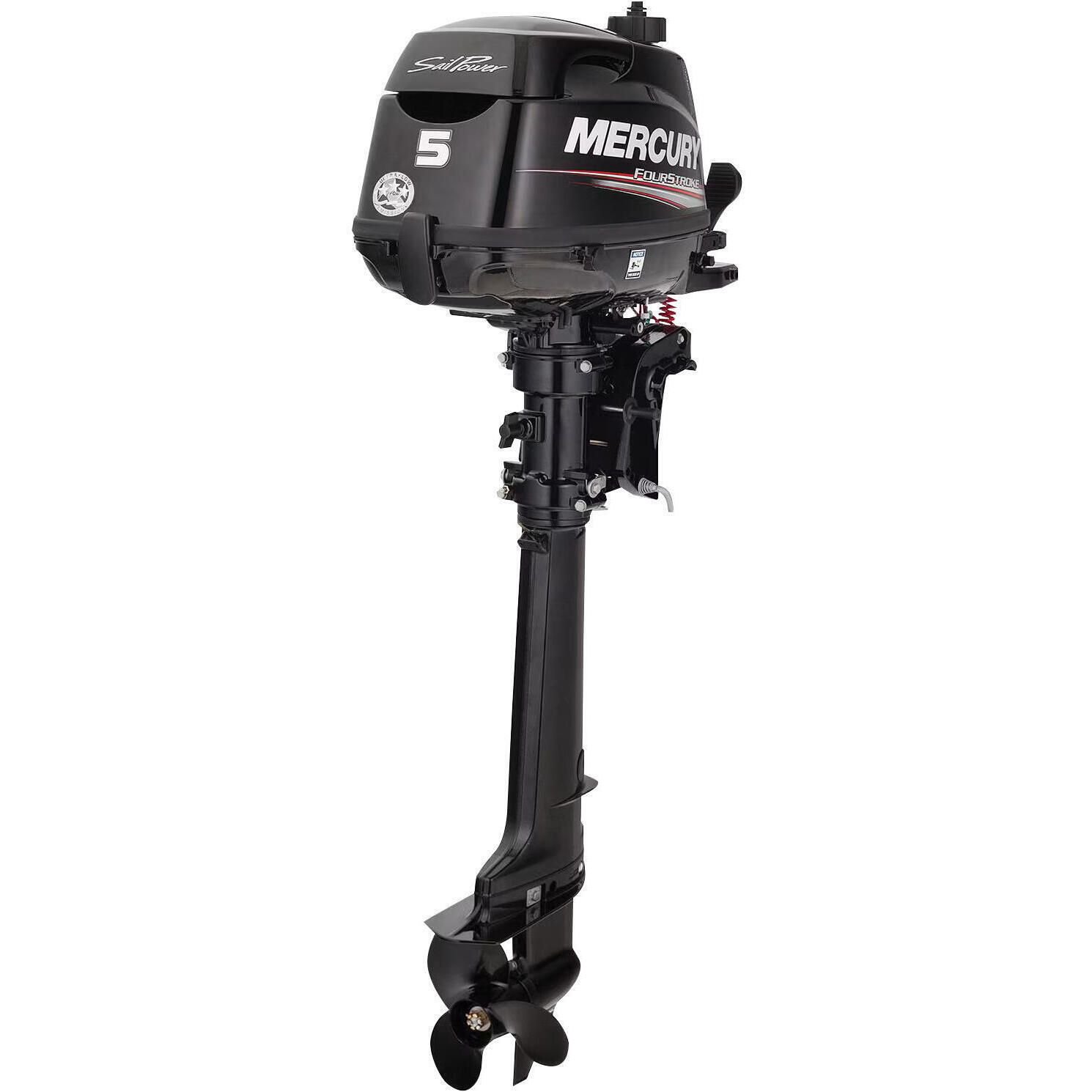
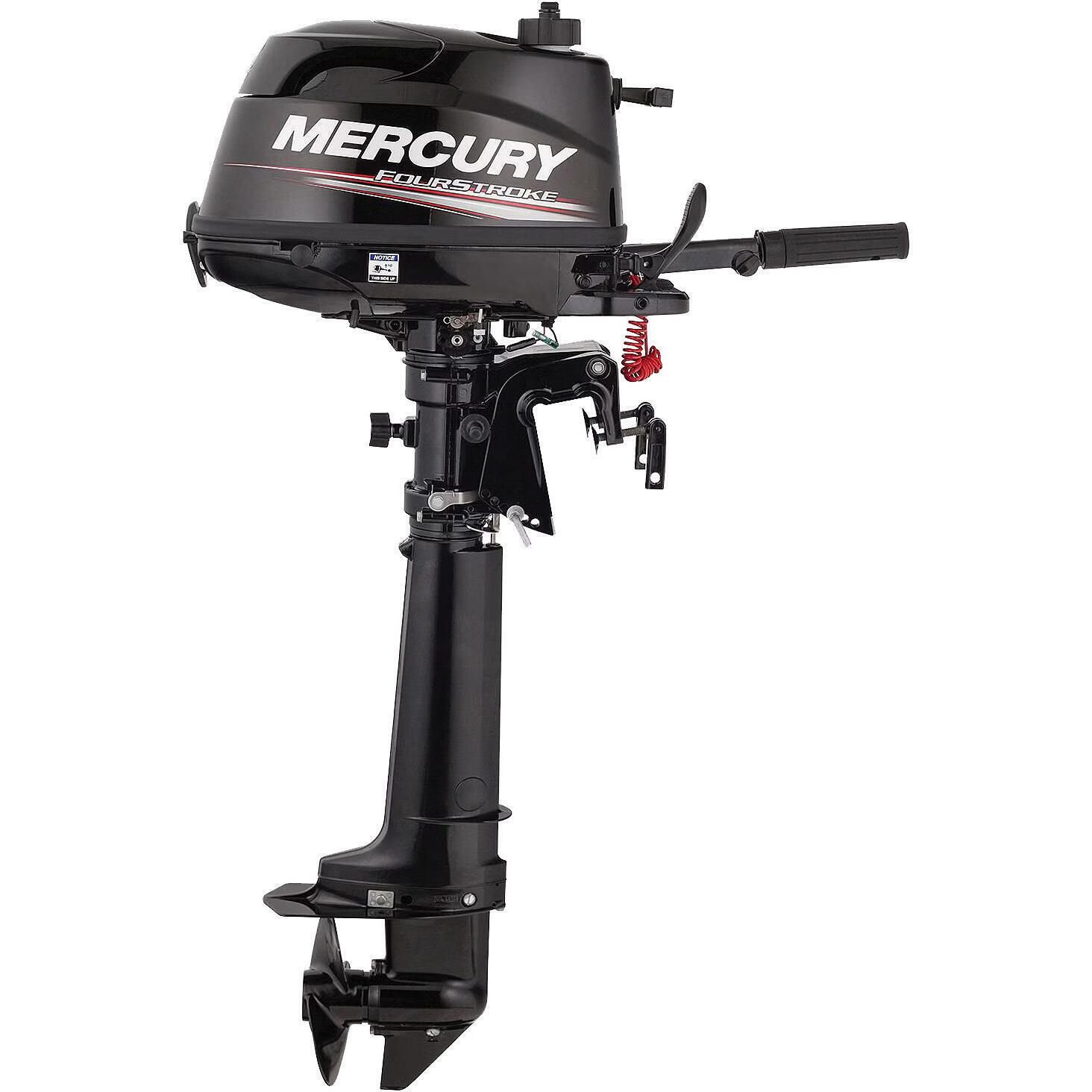
Mercury 5hp Tiller Sail Power FourStroke Outboard Motor, 20″ Shaft – Manual Tilt/Trim – Manual Start
€1,000.00
The Mercury® Sail Power FourStroke outboard motor offers a powerful helping hand on small sailboats. It features a lightweight, compact design, with a lengthened gearcase and high-thrust prop optimized for maneuvering sailboats around crowded marinas. This rugged outboard is designed for years of dependability, offering you nimble, care-free control of your vessel.
- Durable gearcase and high-thrust prop designed specifically for small sailboats
- 4-amp (50 watt) alternator for lighting and charging
- Easy-to-use tiller handle
- Lightweight, compact design
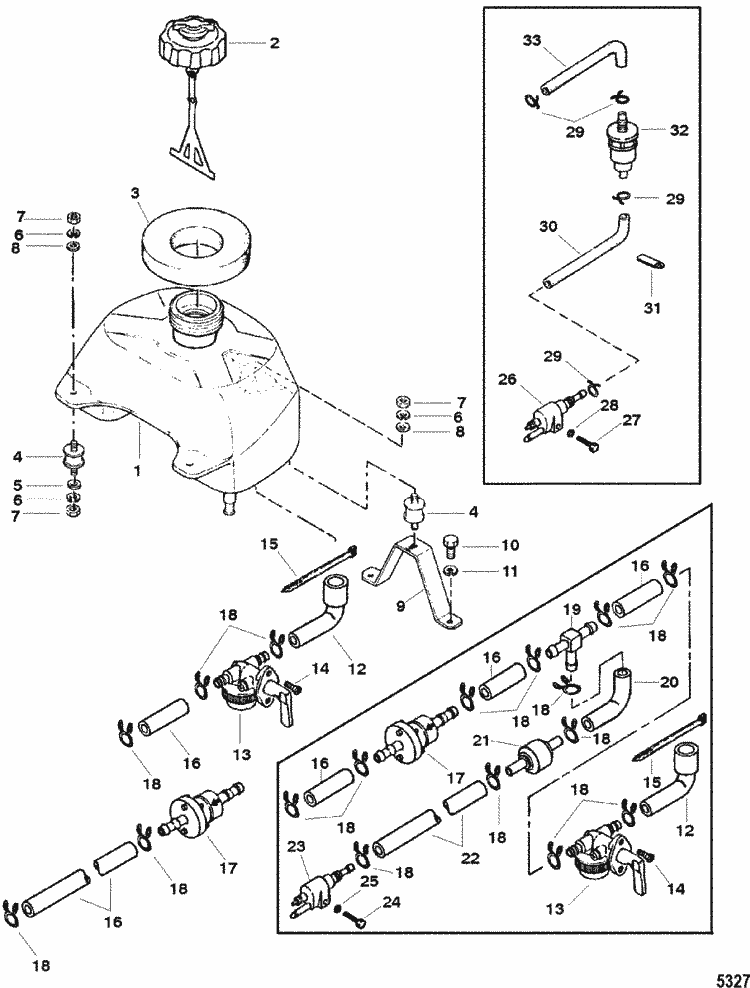
- Integrated on-engine fuel tank
- Can be connected to a remote fuel tank
- Easy-pull manual starting
- Built with saltwater-safe components and corrosion-preventive technologies
- Outstanding power and fuel efficiency
- Easy oil change system keeps maintenance clean and easy
NOTE: When you unpack your engine, please follow the “Engine Break-In Procedure,” which is outlined inside your engine operation and maintenance manual. First, look over your engine before starting. Then, fill it with engine oil, and check its gear lube level. Next, ensure the propeller is included and secure. Lastly, be sure to review your Mercury Marine Limited Warranty, and your Customer Delivery Inspection (CDI) process should be logged on Mercurymarine.com. Failure to comply with the engine break-in procedure can result in severe engine damage not covered by Mercury Marine Limited Warranty.
Specifications
| Horsepower | 5 |
| Starting Type | Manual |
| Steering Type | Tiller |
| Shaft Length | 20″ |
| Model Number | 1F05216KK |
| Trim/Tilt | Manual |
| Fuel Tank Included | Yes |
| Fuel Tank Capacity | .3 gal. |
| Propeller Included | Yes |
| Engine Type | 1-Cylinder |
| Engine Weight | 59 lbs. |
| Recommended Fuel | 87 Octane (Up to 10% Ethanol) |
| Recommended Oil | 10W-30 |
| Pursuit | Recreational Boating |
Description
Mercury 5hp Tiller Sail Power FourStroke Outboard Motor, 20″ Shaft – Manual Tilt/Trim – Manual Start
Choosing the right auxiliary outboard motor often defines how confidently time on the water is experienced. For sailboat owners, tender operators, and small-craft enthusiasts alike, dependable low-horsepower propulsion remains essential. Rather than being treated as an afterthought, auxiliary power increasingly serves as a primary safety, maneuverability, and efficiency solution. Accordingly, the Mercury 5hp Tiller Sail Power FourStroke Outboard Motor, 20″ Shaft – Manual Tilt/Trim – Manual Start has been engineered to meet those exact expectations.
From the outset, this outboard motor is positioned as a purpose-built solution rather than a compromise. Compact dimensions combine with proven four-stroke engineering, while intuitive controls support confident operation across experience levels. As a result, smoother handling, quieter performance, and dependable thrust are delivered consistently—whether navigating a marina, holding position against wind, or motoring through calm inland waterways.
Why the 5HP Sail Power Category Matters
Small outboard motors frequently carry big responsibility. In many real-world sailing scenarios, auxiliary propulsion becomes the decisive factor during docking, emergency maneuvering, or adverse weather adjustments. Consequently, reliability and predictability matter as much as raw output.
Within this context, the Sail Power configuration stands apart. Unlike generic portable outboards, Sail Power models are optimized for sailboat transoms, higher freeboards, and variable load conditions. Therefore, thrust is delivered where and when it is needed most, even at low speeds and under continuous operation.
Additionally, four-stroke technology continues to dominate this segment for good reason. Fuel efficiency, emissions compliance, and reduced vibration align closely with modern boating expectations. As a result, owners benefit not only from performance but also from long-term operational savings and reduced environmental impact.
Designed by Mercury Marine for Purpose-Driven Use
Engineering heritage plays a critical role when evaluating marine propulsion. Decades of research, testing, and real-world deployment inform every design choice. Accordingly, this 5hp Sail Power outboard reflects a focus on durability, user-centered design, and consistent output across varied conditions.
Rather than being oversized or underutilized, the 5hp class strikes an ideal balance. Enough power is provided for controlled maneuvering, while unnecessary weight and complexity are avoided. Consequently, installation remains straightforward, handling stays predictable, and maintenance requirements remain manageable.
Understanding the 20-Inch Shaft Advantage
Shaft length is frequently underestimated, yet it directly affects propulsion efficiency and control. For sailboats in particular, a 20-inch (long) shaft ensures that the propeller remains submerged even in choppy conditions or when the vessel heels slightly.
Because ventilation and cavitation are minimized, thrust remains steady. Consequently, steering corrections become smoother, and engine strain is reduced. Over time, this translates into improved longevity and more comfortable operation.
Manual Tilt and Trim: Simplicity with Purpose
Complex systems often introduce unnecessary risk in marine environments. By contrast, manual tilt and trim mechanisms provide direct, tactile control. When shallow water is encountered, adjustments can be made quickly and intuitively. Similarly, beaching or trailering becomes easier without reliance on hydraulics or electronics.
Furthermore, fewer moving parts result in fewer maintenance concerns. For many owners, this simplicity is not a limitation but a deliberate advantage.
Manual Start Reliability in Real Conditions
Electric start systems offer convenience; however, they also introduce dependency on batteries and wiring. Manual start engines, by comparison, provide independence. Even after extended storage or unexpected power loss, reliable starting remains achievable.
Because of this, manual start configurations continue to be preferred by sailors and minimalists who value self-sufficiency. In emergency scenarios, that preference often proves justified.

Technical Architecture, Performance Dynamics, and Operational Efficiency
Engineering Foundations That Support Consistent Output
Mechanical integrity defines long-term satisfaction in auxiliary propulsion. In this segment, engineering decisions directly influence reliability, efficiency, and user confidence. The Mercury 5hp Tiller Sail Power FourStroke Outboard Motor, 20″ Shaft – Manual Tilt/Trim – Manual Start is constructed around a compact four-stroke powerhead designed to operate smoothly under continuous low-load conditions.
Rather than prioritizing peak horsepower at high RPM, this engine architecture emphasizes torque delivery at lower speeds. Consequently, thrust remains predictable during docking maneuvers, slow cruising, and adverse wind correction. This approach aligns closely with real-world sailboat usage, where steady propulsion matters more than acceleration.
Four-Stroke Engine Design: Efficiency Without Compromise
Four-stroke technology has become the standard for modern auxiliary outboards due to its operational advantages. Fuel is metered precisely, combustion cycles remain controlled, and lubrication is contained within a closed system. As a result, oil mixing is eliminated, exhaust emissions are reduced, and engine cleanliness is improved.
Additionally, vibration levels remain lower compared to legacy two-stroke designs. Because smoother operation reduces operator fatigue, longer run times become more comfortable. Over extended ownership, reduced wear also supports engine longevity and consistent performance.

Fuel System Optimization for Extended Run Time
Fuel efficiency plays a critical role in auxiliary power selection. Small sailboats and tenders often carry limited onboard fuel, making consumption rates especially important. This outboard’s carbureted fuel delivery system is calibrated for steady-state operation rather than aggressive throttle response.
Because fuel draw remains conservative at cruising RPMs, extended run times can be achieved from modest fuel reserves. Furthermore, predictable consumption simplifies trip planning and reduces refueling frequency. For owners who prioritize simplicity and reliability, this balance proves advantageous.
Noise Reduction and Vibration Control
Sound and vibration characteristics often influence perceived quality more than raw specifications. In quiet marinas or peaceful anchorages, excessive engine noise quickly becomes intrusive. For that reason, acoustic dampening and balanced internal components are integral to this design.
Through controlled combustion timing and precision-machined components, operational noise remains subdued. Meanwhile, vibration transfer through the tiller handle is minimized. Consequently, communication onboard remains easier, and situational awareness improves during close-quarters maneuvering.
Cooling System Reliability in Variable Conditions
Effective thermal management ensures consistent output and prevents premature wear. This outboard employs a water-cooling system engineered for low-speed operation, where water intake pressure may vary. By maintaining steady coolant flow, operating temperatures remain within optimal ranges.
Because overheating risks are reduced, confidence during extended idling or slow cruising increases. This reliability proves especially valuable when navigating congested waterways or waiting for marina access.
Propeller Design and Thrust Characteristics
Propeller selection directly influences how efficiently power is translated into motion. In this Sail Power configuration, the propeller is optimized for pushing heavier displacement hulls at controlled speeds. Blade geometry emphasizes grip rather than speed, which minimizes slippage under load.
As a result, thrust delivery feels immediate and controlled. Even when wind or current resistance increases, forward motion remains steady. For sailboat operators, this predictable behavior simplifies helm adjustments and docking alignment.
Gearcase and Transmission Considerations
Shifting performance contributes significantly to overall usability. Smooth engagement between forward, neutral, and reverse gears reduces shock loads on drivetrain components. In this design, gear ratios are selected to complement low-horsepower torque characteristics.
Because engagement remains controlled, abrupt jolts are avoided. This not only protects internal components but also improves onboard comfort. Over time, reduced mechanical stress supports durability and quieter operation.
Operational Efficiency at Low and Mid RPM Ranges
Unlike high-output engines that spend most of their time throttled back, auxiliary outboards frequently operate within narrow RPM bands. Therefore, efficiency in these ranges becomes critical. This engine’s power curve is tuned specifically for low-to-mid RPM efficiency.
Fuel consumption remains stable, exhaust output stays clean, and thermal balance is preserved. Consequently, owners benefit from lower operating costs and reduced environmental footprint without sacrificing usability.
Maintenance Accessibility and Ownership Practicality
Routine maintenance influences total cost of ownership as much as purchase price. Access points on this outboard are arranged to simplify common service tasks such as oil changes, spark plug inspection, and fuel system checks.
Because service intervals are straightforward and component access is unobstructed, downtime is minimized. For owners who prefer hands-on maintenance, this accessibility proves valuable. Alternatively, service technicians benefit from reduced labor time, which can lower service costs.
Application-Focused Design for Practical Sailing Needs
Auxiliary propulsion is rarely purchased for theoretical performance. Instead, real-world situations define value. The Mercury 5hp Tiller Sail Power FourStroke Outboard Motor, 20″ Shaft – Manual Tilt/Trim – Manual Start has been developed specifically for scenarios where control, predictability, and reliability take priority over excess output.
Rather than serving a single narrow function, this outboard supports a broad range of applications. From calm-water cruising to urgent maneuvering, performance characteristics remain consistent. Consequently, operators gain confidence knowing that expected behavior aligns with actual conditions.Mercury 5hp Tiller Sail Power FourStroke
Sailboat Docking and Close-Quarters Maneuvering
Docking remains one of the most demanding aspects of sailboat operation. Wind, current, and limited space often converge, leaving little margin for error. In these moments, smooth throttle response and predictable thrust become critical.Mercury 5hp Tiller Sail Power FourStroke
Because this 5hp Sail Power outboard delivers controlled power at low RPM, precise adjustments are easily achieved. Forward and reverse engagement feels deliberate rather than abrupt. As a result, alignment corrections can be made calmly, reducing stress and minimizing risk of contact damage.Mercury 5hp Tiller Sail Power FourStroke
Long-Shaft Advantage in Variable Sea States
Sailboats frequently operate with higher transoms and variable trim angles. When waves or wake are introduced, short-shaft outboards may lose propeller immersion. By contrast, the 20-inch shaft length ensures consistent water contact even as hull attitude changes.
Because cavitation is reduced, thrust interruptions are minimized. Steering input therefore translates directly into motion. Over time, this consistency supports smoother handling and greater operator confidence, especially in unfamiliar harbors.
Emergency Propulsion and Safety Scenarios
Auxiliary engines often serve as a contingency system rather than a primary propulsion source. When wind dies unexpectedly, rigging fails, or traffic conditions change rapidly, dependable auxiliary power becomes essential.
Manual start functionality plays a crucial role in these scenarios. Without reliance on batteries or electrical systems, engine engagement remains possible even after prolonged inactivity. Consequently, preparedness increases without added system complexity.
Coastal Cruising and Inland Waterway Use
For coastal cruisers and inland waterway sailors alike, extended low-speed motoring is common. Narrow channels, no-wake zones, and congested passages often require steady propulsion over extended periods.
Because fuel consumption remains efficient at cruising RPMs, longer distances can be covered without frequent refueling. Noise levels also remain subdued, which preserves onboard comfort and minimizes disturbance to surrounding vessels.
Tender and Dinghy Applications
Beyond sailboat transoms, this outboard also serves effectively as a tender engine. Dinghies used for shore access, provisioning, or anchorage transit benefit from lightweight handling and straightforward controls.Mercury 5hp Tiller Sail Power FourStroke
Manual tilt functionality proves especially useful in shallow areas or beach landings. By raising the engine quickly, propeller damage is avoided. Consequently, versatility increases without sacrificing durability.
Ownership Experience Across Skill Levels
Inclusive design ensures that operators with varying experience levels feel equally supported. New boat owners benefit from intuitive controls and predictable behavior. Meanwhile, experienced sailors appreciate mechanical simplicity and reduced failure points.
Because learning curves remain short, confidence builds quickly. Over time, familiarity encourages smoother operation and safer handling across diverse conditions.Mercury 5hp Tiller Sail Power FourStroke
Comparison: 5HP Sail Power vs. Higher Horsepower Alternatives
Higher horsepower outboards often appear appealing; however, increased output introduces trade-offs. Added weight, higher fuel consumption, and more complex systems may outweigh benefits for auxiliary use.
In contrast, the 5hp Sail Power configuration aligns closely with typical sailboat needs. Enough thrust is provided for control and safety, while unnecessary excess is avoided. Consequently, balance rather than brute force defines overall value.
Comparison: Long Shaft vs. Short Shaft Configurations
Shaft length selection significantly affects performance. Short-shaft outboards may suit low-freeboard vessels, yet sailboats often demand greater immersion depth. A long shaft ensures consistent thrust delivery across a wider range of operating conditions.Mercury 5hp Tiller Sail Power FourStroke
Because ventilation risks are reduced, engine strain decreases. Over extended ownership, this contributes to improved reliability and smoother operation.Mercury 5hp Tiller Sail Power FourStroke
Evaluating the 5HP Segment with a Practical Lens
Within the auxiliary outboard category, the 5hp segment represents a convergence of efficiency, manageability, and functional power. However, not all 5hp outboards are engineered with sailboat-specific realities in mind. Accordingly, informed comparison becomes essential before committing to a purchase.
Rather than focusing solely on advertised horsepower, experienced buyers evaluate shaft length compatibility, torque delivery at low RPM, system simplicity, and long-term ownership implications. When viewed through this lens, the Mercury 5hp Tiller Sail Power FourStroke Outboard Motor, 20″ Shaft – Manual Tilt/Trim – Manual Start occupies a clearly defined and defensible position.Mercury 5hp Tiller Sail Power FourStroke
Comparative Positioning Against Standard 5HP Outboards
Many competing 5hp outboards are designed primarily for small fishing boats or inflatables. While usable on sailboats, these models often feature shorter shafts, lighter-duty gearcases, or propellers optimized for speed rather than thrust.
By contrast, the Sail Power configuration emphasizes displacement pushing power. Because propeller geometry and gearing are matched to sailboat hull characteristics, performance remains stable under load. Consequently, fewer throttle adjustments are required, and operator workload is reduced during precision maneuvers.
Comparison with Electric Start and Power Trim Variants
Electric start and power trim systems offer convenience; however, they also introduce dependency on electrical infrastructure. Batteries, wiring, and charging systems become integral to operation. In auxiliary applications, these dependencies may complicate emergency readiness.
Manual start and manual tilt/trim systems eliminate these variables. As a result, system independence increases. For many sailboat owners, this trade-off favors reliability over convenience, particularly when the auxiliary engine serves as a safety asset.
Weight, Balance, and Transom Stress Considerations
Engine weight directly affects sailboat trim and handling. Heavier outboards can introduce stern squat or alter sailing balance. In contrast, a compact four-stroke 5hp engine maintains a manageable weight profile.
Because transom stress remains lower, structural integrity is preserved over time. Additionally, installation and removal become easier, which benefits seasonal storage and servicing routines.Mercury 5hp Tiller Sail Power FourStroke
Fuel Consumption and Operating Cost Analysis
Operating cost extends beyond initial purchase price. Fuel efficiency, maintenance intervals, and consumable requirements collectively shape total cost of ownership.
This outboard’s efficiency-focused tuning supports reduced fuel burn during extended low-speed operation. Consequently, annual fuel costs remain modest for most users. Oil changes and routine service tasks are straightforward, which helps contain maintenance expenses over time.Mercury 5hp Tiller Sail Power FourStroke
Service Intervals and Maintenance Predictability
Predictable service schedules simplify ownership planning. Routine maintenance tasks—such as oil changes, spark plug inspection, and gearcase oil replacement—follow clearly defined intervals.
Because access points are unobstructed, service time is reduced. Whether maintenance is performed personally or by a technician, predictability supports lower long-term costs and fewer unexpected issues.Mercury 5hp Tiller Sail Power FourStroke
Durability and Long-Term Reliability Factors
Auxiliary outboards often experience intermittent usage patterns, including long periods of inactivity. Engines that tolerate storage well provide significant value in these scenarios.
Manual systems and proven four-stroke architecture support consistent restarting after storage. As a result, reliability remains high even when usage frequency varies seasonally.Mercury 5hp Tiller Sail Power FourStroke


Reviews
There are no reviews yet.