

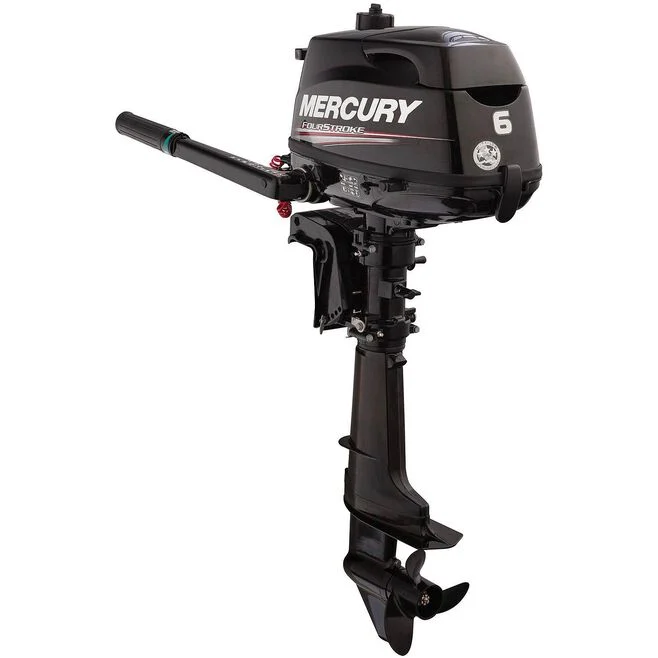
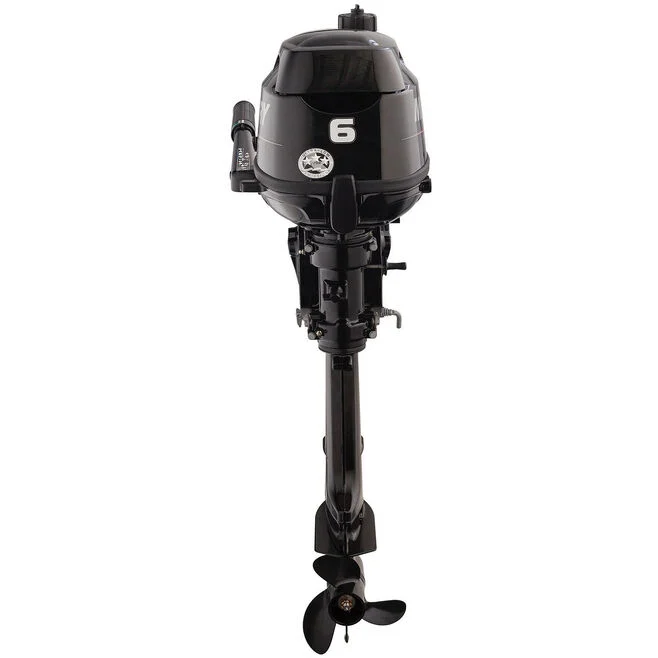
Mercury 6hp Tiller FourStroke Outboard Motor, 15″ Shaft – Manual Tilt/Trim, Manual Start
€1,113.00
Mercury® portable outboard motors are small in size and big on dependability, with plenty of power to handle small jon boats, tender boats, small inflatables and small aluminum boats. They feature a lightweight, compact design for convenient transport, an on-engine fuel tank and a quick-clamp transom bracket for easy installs. From remote waters to your local lake, these rugged little outboards are ready to handle all your adventure needs.
- Easy-to-use tiller handle
- Lightweight, compact portable design
- Quick-clamp transom bracket
- Integrated on-engine fuel tank
- Can be connected to a remote fuel tank
- Easy-pull manual starting
- Built with saltwater-safe components and corrosion-preventive technologies
- Outstanding power and fuel efficiency
- Easy oil change system keeps maintenance clean and easy
NOTE: When you unpack your engine, please follow the “Engine Break-In Procedure,” which is outlined inside your engine operation and maintenance manual. First, look over your engine before starting. Then, fill it with engine oil, and check its gear lube level. Next, ensure the propeller is included and secure. Lastly, be sure to review your Mercury Marine Limited Warranty, and your Customer Delivery Inspection (CDI) process should be logged on Mercurymarine.com. Failure to comply with the engine break-in procedure can result in severe engine damage not covered by Mercury Marine Limited Warranty.
Specifications
| Horsepower | 6 |
| Starting Type | Manual |
| Steering Type | Tiller |
| Shaft Length | 15″ |
| Engine Type | 1-Cylinder |
| Engine Weight | 57 lbs. |
| Fuel Tank Capacity | .3 gal. |
| Fuel Tank Included | Yes |
| Propeller Included | Yes |
| Pursuit | Recreational Boating |
| Recommended Fuel | 87 Octane (Up to 10% Ethanol) |
| Recommended Oil | 10W-30 |
| Trim/Tilt | Manual |
| Model Number | 1FX6201KK |
Description
Mercury 6hp Tiller FourStroke Outboard Motor — Power That Earns Trust
Performance expectations for small outboard motors have evolved significantly, and reliability is no longer considered optional. Today, users expect consistent output, low operating costs, and straightforward handling, all within a compact footprint. Developed to meet these modern demands, the Mercury 6hp Tiller FourStroke Outboard Motor, 15″ Shaft – Manual Tilt/Trim, Manual Start represents a deliberate balance between power, efficiency, and long-term usability.
Rather than emphasizing excess complexity, this outboard motor has been engineered around practical ownership realities. From initial installation through years of routine operation, every design choice supports confidence on the water. As a result, both new and experienced boat owners can rely on predictable performance without unnecessary learning curves.
Purpose-Built for Small Craft Excellence
Small boats require engines that respond intuitively under varying conditions. Because weight distribution, hull shape, and load capacity differ widely, a motor must adapt rather than dominate. With this understanding, Mercury designed the 6hp FourStroke to deliver smooth acceleration and steady cruising speeds while maintaining excellent control at low throttle.
In calm waters, quiet operation enhances the overall experience. Meanwhile, in changing conditions, dependable torque ensures that maneuverability remains uncompromised. Consequently, this motor supports a wide range of on-water activities without forcing trade-offs between comfort and control.
A FourStroke Design Focused on Efficiency and Longevity
Efficiency has been prioritized at every level of the engine’s design. Through advanced combustion management, fuel usage is optimized while emissions remain reduced. Because of this, owners benefit from extended run times per tank and lower lifetime operating expenses.
Unlike older two-stroke alternatives, the FourStroke configuration supports smoother power delivery and reduced vibration. Over time, mechanical wear is minimized, and maintenance intervals become easier to manage. Therefore, long-term ownership is simplified, particularly for users who value predictability over peak output extremes.
Designed to Support Confident Operation
Confidence on the water begins with intuitive control. For this reason, the tiller handle system has been designed to offer precise throttle response while maintaining ergonomic comfort. Steering input feels natural, allowing operators to focus on navigation rather than engine behavior.
Manual start functionality reinforces this reliability-focused philosophy. Because electrical dependencies are minimized, ignition remains dependable even after extended storage or in remote locations. As a result, peace of mind is reinforced every time the motor is prepared for use.
Key Benefits That Drive Real-World Value
When evaluating an outboard motor, features matter only when they translate into meaningful advantages. This model has been designed with that principle firmly in place.
Highlighted Product Benefits
-
Consistent 6hp output supporting stable propulsion across varying loads
-
FourStroke fuel efficiency reducing consumption and operating costs
-
Manual start reliability minimizing dependency on electrical systems
-
Tiller steering precision enhancing low-speed maneuverability
-
Reduced vibration levels contributing to onboard comfort
-
Compact and lightweight construction simplifying transport and installation
-
Durable engineering standards supporting long-term ownership
Each benefit has been incorporated to address common user concerns while avoiding unnecessary complication.

Shaft Length Optimized for Versatility
Shaft length plays a critical role in engine compatibility and performance. With a 15-inch shaft, this outboard motor aligns seamlessly with many small boats, tenders, and inflatables. Because proper transom alignment is achieved, cavitation is reduced and thrust efficiency is improved.
In addition, shallow-water operation becomes more manageable. Manual tilt functionality allows the engine to be raised when navigating near shorelines or obstacles. Consequently, flexibility is enhanced without introducing complex hydraulic systems.
Manual Tilt and Trim: Practical Control Without Complexity
Manual tilt and trim systems are often preferred by owners who value mechanical simplicity. Instead of relying on powered components, adjustments can be made quickly and directly. This approach supports durability while reducing long-term maintenance considerations.
By allowing the operator to fine-tune the engine’s angle, performance can be optimized for varying speeds and load conditions. At the same time, shallow-water navigation becomes safer and more controlled. Therefore, versatility is achieved without sacrificing reliability.
Inclusive Design for a Broad Range of Users
Boat ownership spans diverse experience levels, physical abilities, and use cases. Recognizing this, Mercury has focused on inclusive usability throughout the design. Controls are positioned to remain accessible, and operational feedback is clear and predictable.
First-time users are supported through straightforward mechanics and forgiving handling characteristics. Meanwhile, experienced operators benefit from consistent response and efficient power management. In this way, the motor adapts to its user rather than demanding adaptation in return.
Quiet Operation That Enhances the On-Water Experience
Noise levels can significantly influence comfort, especially during extended outings. Through refined engineering and vibration control, operational noise has been reduced. As a result, conversations remain clear, and environmental disturbance is minimized.
For anglers, quieter propulsion supports a more natural fishing environment. For leisure users, the overall experience feels more relaxed and immersive. Therefore, enjoyment is increased regardless of how the motor is used.
Built for Ownership, Not Just Initial Performance
Short-term power figures rarely tell the full story. Instead, long-term reliability, ease of maintenance, and consistent output define true value. With this motor, service access has been simplified, and proven Mercury engineering standards have been applied throughout.
Because maintenance requirements remain manageable, ownership becomes less time-consuming and more predictable. Over time, this translates into lower total cost of ownership and greater confidence in every outing.
Precision Engineering That Supports Predictable Power
Engineering consistency defines the operational character of the Mercury 6hp Tiller FourStroke Outboard Motor, 15″ Shaft – Manual Tilt/Trim, Manual Start. Rather than chasing peak output metrics, Mercury has concentrated on delivering power that remains usable across real-world operating ranges. Through this approach, acceleration feels controlled, cruising remains stable, and low-speed maneuvering is executed with confidence.
Every mechanical component has been designed to function cohesively. Because tolerances are tightly managed, internal friction is reduced and efficiency is improved. As a result, power delivery remains smooth while mechanical stress is minimized over extended periods of use.
FourStroke Powerhead Design Explained
At the core of this outboard motor lies a compact FourStroke powerhead engineered for durability and efficiency. Combustion cycles are precisely timed, allowing fuel to be burned more completely. Consequently, energy is converted into propulsion rather than wasted through heat or vibration.
Unlike legacy engine designs, this configuration promotes smoother torque curves. Power builds progressively rather than abruptly, which supports stable handling in tight spaces. Therefore, docking, trolling, and shoreline navigation become easier to manage.
Internal Component Harmony and Load Management
Mechanical reliability depends on how well components interact under load. For this reason, the crankshaft, camshaft, and valve train have been balanced to reduce rotational stress. Because loads are distributed evenly, wear patterns remain consistent over time.
Additionally, thermal management has been carefully addressed. Heat dissipation pathways allow operating temperatures to remain stable even during extended use. As a result, performance does not degrade during longer outings, and internal components are protected from premature fatigue.
Throttle Response Tuned for Control
Throttle response has been calibrated to prioritize precision rather than abrupt acceleration. When throttle input is applied, engine speed increases smoothly. This behavior supports predictable movement, especially in crowded marinas or shallow waterways.
By avoiding aggressive response curves, operator fatigue is reduced. At the same time, confidence is reinforced for users who prefer controlled movement over sudden surges. Therefore, usability is enhanced without sacrificing responsiveness.
Gear Ratio Optimization for Versatile Performance
Gear ratios play a critical role in how power is translated into motion. With this model, gearing has been optimized to support both low-speed torque and efficient cruising. Because of this balance, the motor adapts effectively to varying load conditions.
Heavier loads benefit from steady torque output, while lighter vessels experience smooth acceleration. Consequently, the motor remains versatile across different hull types and usage scenarios.
Fuel Delivery and Combustion Efficiency
Fuel efficiency begins with accurate delivery. In this engine, fuel metering has been refined to match demand precisely. By supplying only the required amount of fuel at each operating range, waste is reduced and efficiency is improved.
Combustion chambers have been shaped to promote even flame propagation. As a result, fuel burns more completely, emissions are lowered, and engine cleanliness is maintained. Over time, this contributes to reduced maintenance requirements and sustained performance.
Vibration Reduction Through Structural Design
Vibration affects comfort as well as mechanical longevity. To address this, Mercury has incorporated vibration-dampening strategies throughout the engine assembly. Mounting points have been engineered to isolate movement, while internal balancing minimizes oscillation.
Because vibration is reduced, operator comfort is enhanced during longer trips. Additionally, structural fatigue is limited, extending the service life of both the engine and the boat’s transom.
Cooling System Reliability Under Variable Conditions
Consistent cooling is essential for engine longevity. This outboard motor employs a water-cooling system designed to function reliably across a range of operating environments. Whether running at idle or sustained cruising speeds, coolant flow remains steady.
Debris resistance has been considered as well. Intake pathways are designed to reduce blockage risk, which supports stable temperatures in shallow or sediment-heavy waters. Therefore, reliability is maintained even in less-than-ideal conditions.
Exhaust Management and Noise Control
Exhaust routing has been engineered to minimize noise while maintaining efficient gas flow. By directing exhaust through water where appropriate, sound levels are reduced without restricting performance.
This approach benefits both users and surrounding environments. Quieter operation supports relaxed use, while exhaust efficiency ensures that power output remains consistent. As a result, the motor performs effectively without creating unnecessary disturbance.
Manual Start System Engineering
Manual start systems require precise mechanical alignment to remain dependable. In this design, the recoil mechanism has been engineered for smooth engagement and consistent tension. Because fewer electronic components are involved, potential failure points are reduced.
Cold starts and post-storage starts remain reliable as a result. For users operating in remote locations or intermittent schedules, this reliability becomes especially valuable.
Performance Consistency Across Use Cases
Performance is rarely defined by a single condition. Instead, consistency across varying scenarios determines true value. Whether the motor is used for short trips, extended cruising, or frequent stop-and-go operation, behavior remains predictable.
Fuel Efficiency, Emissions Performance & FourStroke Ownership Advantages
Efficiency as a Core Design Principle
Fuel efficiency has been engineered into every operating phase of the Mercury 6hp Tiller FourStroke Outboard Motor, 15″ Shaft – Manual Tilt/Trim, Manual Start. Rather than functioning as an added benefit, economical fuel usage serves as a foundational performance objective. Because fuel delivery and combustion are precisely managed, energy output remains proportional to demand.
As a result, operators experience extended run times without frequent refueling. This advantage becomes particularly valuable during longer excursions, remote operation, or repeated daily use. Over time, reduced fuel consumption translates into measurable cost savings and greater operational independence.
How FourStroke Technology Improves Fuel Economy
FourStroke engines operate through a more controlled combustion cycle compared to older two-stroke designs. In this configuration, fuel is burned only during the power stroke, while intake and exhaust processes are managed separately. Consequently, less unburned fuel is lost during operation.
Because combustion efficiency is improved, throttle input results in predictable engine response. This efficiency reduces unnecessary fuel draw at lower speeds, which is especially beneficial for trolling, idling, and low-speed navigation. Therefore, fuel economy remains consistent across a wide range of operating conditions.
Real-World Fuel Savings Over Time
Fuel savings are not theoretical benefits; they accumulate through routine use. With optimized metering and efficient combustion, consumption remains stable even during variable throttle operation. Because of this stability, trip planning becomes easier and refueling frequency is reduced.
For owners who operate regularly, these savings compound over months and years. Instead of fluctuating operating costs, budgeting becomes more predictable. As a result, long-term ownership feels more manageable and financially sustainable.
Reduced Emissions Through Cleaner Combustion
Environmental responsibility has become an important consideration for many boat owners. Through advanced combustion control, this outboard motor produces fewer emissions compared to less efficient engine designs. Because fuel burns more completely, harmful byproducts are minimized.
Lower emissions contribute to cleaner waterways and improved air quality around marinas and shorelines. In regulated environments, compliance becomes less burdensome. Consequently, owners can operate with confidence while aligning with evolving environmental standards.
Compliance Without Compromise
Meeting emissions regulations often requires complex systems that increase maintenance demands. In this case, compliance has been achieved through efficient engineering rather than added complexity. By optimizing combustion and fuel delivery, emissions are reduced naturally.
This approach supports long-term reliability while avoiding excessive component integration. As a result, owners benefit from regulatory compliance without sacrificing durability or ease of maintenance.
Quieter Operation as an Efficiency Benefit
Efficiency extends beyond fuel usage. When combustion is controlled and vibration is minimized, operational noise is reduced. This quieter profile improves onboard comfort while reducing disturbance to surrounding environments.
For anglers, reduced noise supports a more natural fishing experience. For recreational users, conversations remain clear, and overall enjoyment increases. Therefore, efficiency contributes directly to quality of use, not just cost savings.
Lower Maintenance Requirements Compared to Two-Stroke Engines
FourStroke engines typically require less frequent maintenance than traditional two-stroke alternatives. Because fuel and oil systems are separated, oil consumption is reduced. This separation minimizes residue buildup and keeps internal components cleaner over time.
As a result, service intervals are extended, and maintenance tasks remain straightforward. For owners, this means fewer interruptions and lower long-term service costs. Over extended ownership periods, these benefits become increasingly significant.
Oil Management Designed for Longevity
Oil circulation plays a vital role in engine health. In this design, lubrication has been engineered to support consistent coverage under varying loads and speeds. Because oil delivery remains stable, internal friction is reduced and component life is extended.
Routine oil changes are simplified due to accessible service points. Consequently, maintenance becomes more predictable and less time-consuming. This ease of care supports confident ownership, even for users with limited mechanical experience.
Reduced Odor and Cleaner Operation
Cleaner combustion results in fewer exhaust odors during operation. This improvement enhances comfort, particularly during low-speed operation or when idling near passengers.
By minimizing unburned fuel discharge, both the engine and surrounding water remain cleaner. Over time, this contributes to a more pleasant boating environment and reduces the need for additional cleaning.
Ownership Benefits That Extend Beyond the Engine
Efficiency-driven design influences the entire ownership experience. Lower fuel costs, reduced maintenance demands, and quieter operation combine to create tangible value. Because these benefits accumulate gradually, satisfaction often increases with continued use.
For users who prioritize reliability, sustainability, and predictable costs, these advantages align naturally with long-term expectations. Therefore, ownership becomes less about managing equipment and more about enjoying time on the water.
Supporting Diverse Use Patterns
Not all users operate their boats in the same way. Some prioritize short recreational trips, while others require extended runtime for work or transport. Because efficiency remains consistent across different use patterns, this motor adapts effectively.
Light-duty use benefits from minimal fuel waste, while frequent operation gains from reduced cumulative costs. In both cases, performance remains stable and dependable.
FourStroke Efficiency as a Strategic Investment
Choosing a FourStroke outboard motor often represents a strategic decision rather than a short-term purchase. Through lower operating costs, improved compliance, and extended service life, value is delivered over time rather than upfront alone.
This model exemplifies that philosophy. By aligning engineering efficiency with real-world usability, it supports ownership goals that extend beyond immediate performance metrics.



Reviews
There are no reviews yet.