

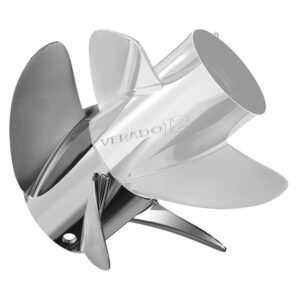
Verado12 (27.5″) MERCURY LH 4-Blade Front Propeller 48-8M0166985
€1,060.00
Description
Verado12 (27.5″) MERCURY LH 4 Blade Front Propeller 48-8M0166985
The Verado12 (27.5″) MERCURY LH 4-Blade Front Propeller 48-8M0166985 exists for operators who demand elevated rig behavior, measurable on-water efficiency, and consistent control across changing conditions. When vessels push into higher RPM ranges, prop selection determines whether a boat performs at peak efficiency or sacrifices thrust to turbulence, drag, and slip. Because propulsion is the bridge between mechanical output and hydrodynamic reality, every aspect of the design affects acceleration, lift, steering weight, and stability.MERCURY LH 4 Blade Front Propeller
Operators often seek more than a part number or singular upgrade. Instead, they look for a performance intervention—a way to reclaim throttle authority, expand usable trim angles, and optimize real torque delivery rather than theoretical horsepower. Consequently, this propeller exists at the intersection of practical improvement and engineered precision.MERCURY LH 4 Blade Front Propeller
Although many aftermarket solutions appear comparable on paper, few deliver meaningful steering discipline, low-slip launch control, and multi-speed consistency simultaneously. This propeller is designed to provide all three.MERCURY LH 4 Blade Front Propeller
From Real-World Handling to Performance Reliability
Many operators report specific problems before upgrading. Importantly, these issues are not abstract—they appear during routine use:
-
Bow rise that lingers too long during hole-shot
-
Trim angles that feel “usable but narrow”
-
Steering that demands too much correction in quartering seas
-
Ventilation during hard trim applications
-
RPM fluctuation under mid-range acceleration
-
Loss of bite in confused water or heavy traffic wake
The Verado12 (27.5″) MERCURY LH 4-Blade Front Propeller 48-8M0166985 targets these friction points directly. Moreover, it does so without requiring disruptive modification to the vessel’s running gear. Instead, performance is added through geometry, pitch accuracy, and blade engagement efficiency.MERCURY LH 4 Blade Front Propeller
Geometry, Pitch & Traction Fundamentals
Hydrodynamic Leverage Begins With Blade Interaction
Although horsepower initiates motion, blade geometry converts that force into progress. Unlike 3-blade alternatives that often struggle under heavier load conditions, the 4-blade front configuration produces a cleaner torque curve. Because of this, acceleration improves without requiring additional fuel or calibration changes.MERCURY LH 4 Blade Front Propeller
Pitch Stability at 27.5″
The 27.5-inch pitch was selected to achieve an equilibrium between thrust authority and efficient RPM utilization. Higher pitch can feel faster on flat water, yet it often causes drag penalties when correcting course or navigating wake. Lower pitch may launch aggressively, but it sacrifices momentum and trim stability. This configuration achieves middle-band control that supports:
-
Heavier loads without bogging
-
Superior bite during throttle adjustments
-
Consistent acceleration curves
-
True hydrodynamic discipline at speed
Consequently, the user experiences forward motion that feels unified rather than fragmented.
Design Intent for System Compatibility
Because many Verado owners invest in premium propulsion, they expect upgrades that respect factory tolerances. This propeller supports that expectation by aligning mass balance, rake, and pitch precision in a way that integrates with Mercury Verado systems rather than working against them.MERCURY LH 4 Blade Front Propeller
Functional Purpose, Not Ornamental Hardware
One theme remains central: this propeller is not decorative performance. Instead, it is functional performance that translates into measurable behavioral change on the water. Turning radiuses tighten. Ventilation drops. Trim angles become useful through a broader band. The vessel behaves as though its center of gravity is cooperating with its propulsion rather than fighting it.MERCURY LH 4 Blade Front Propeller
1. Lift & Throttle Integrity
Vessels remain on plane more naturally, which supports stability in variable water states. Acceleration becomes a progression rather than a negotiation.Verado12
2. Directional Confidence
Steering inputs feel proportional to output, giving operators a sense of conversational control rather than reactive correction.
3. Efficiency Gains Without Engine Changes
Performance increases exist as a product of design, not fuel consumption. No tuning, re-mapping, or aftermarket calibration becomes mandatory.
How Engineering Choices Convert to Real Handling Improvements
The Verado12 (27.5″) MERCURY LH 4-Blade Front Propeller 48-8M0166985 does more than spin water into thrust. It reorganizes pressure loads, water adhesion characteristics, slip control, and steering leverage to ensure that force applied by the drive becomes consistent acceleration rather than reactive resistance. Because the 4-blade geometry maintains cleaner contact with water, especially during transitions between trim angles, thrust integrity remains intact even when ambient conditions shift.MERCURY LH 4 Blade Front Propeller
Although some propellers behave competitively at either low or high speed, this configuration performs through the entire acceleration curve. Therefore, operators maintain control instead of constantly adapting to the propeller’s behavior.MERCURY LH 4 Blade Front Propeller
Blade Area & Fluid Management
More blade surface means more water management per revolution. Yet, too much surface area increases drag; too little sacrifices lift. This configuration lands in a critical equilibrium zone. It captures, channels, and redirects water without overloading engine output.
Rake & Cup Geometry for Hydrodynamic Authority
Rake refers to the angle of the blade relative to the hub. Cup refers to curvature at the trailing edge. When calibrated correctly:
-
Bow lift increases through controlled rake leverage
-
Water adhesion remains predictable during trim input
-
Thrust channels forward rather than dispersing laterally
-
Steering load becomes more proportional and less fatigued
Consequently, the vessel lifts sooner, planes faster, and tracks straighter.
Predictable RPM Range Under Load
Acceleration depends on how the propeller handles early torque application. Rather than surging into RPM jumps, this propeller translates increasing throttle into a progressive and predictable curve. Because of cleaner water management, RPM pulses diminish and throttle changes behave more linearly.MERCURY LH 4 Blade Front Propeller
Mid-Range Efficiency
Mid-range efficiency is where most operators spend their time. Speed, fuel economy, comfort, and steering discipline intersect here. With this configuration, the mid-band supports:MERCURY LH 4 Blade Front Propeller
-
Stronger hold during moderate chop
-
Deeper usable trim before ventilation
-
Safer cornering in loaded conditions
-
RPM consistency without chasing throttle
These behaviors convert into something boaters instantly feel: confidence.
Verado12 Recognizing the Difference
Cavitation is micro-bubble formation from pressure imbalance.
Ventilation is atmospheric air slipping into the prop path.
Both destroy thrust efficiency.
Why This Propeller Reduces Both
Because of its shape and pitch stability, water attaches to the blade face instead of slipping away. Even at higher trim, the prop remains engaged. Consequently, operators gain:
-
Less slip under load
-
Less bow porpoising
-
Lower steering correction demand
-
Higher usable trim angles
This is critical for offshore conditions where the water rarely behaves predictably.MERCURY LH 4 Blade Front Propeller
Principle 1: Hydrodynamic Continuity
Rather than fighting water, the blade guides it. Force becomes forward motion, not wasted turbulence.
Principle 2: Throttle Efficiency
Engines work smarter, not harder. Fuel translates into movement rather than friction loss.
Principle 3: Predictable Steering Integrity
Handling becomes conversational. Inputs make sense. Responses feel natural.
| Performance Category | User Experience Outcome |
|---|---|
| Hole-Shot Launch | Gets on plane faster; bow rise moderates sooner |
| Mid-Range Thrust | Strong acceleration without RPM instability |
| Steering Pressure | Feels lighter, especially during cornering |
| Trim Range | Wider usable band before ventilation |
| Fuel Efficiency | Gains present due to reduced drag & slip |
| Ride Stability | Greater predictability in chop and turns |
Even without engine tuning, users report meaningful gains because efficiency begins at the propeller.
Real-World Scenarios, Use Personas & Performance Matchmaking
From Dock to Offshore: Where This Propeller Changes Vessel Behavior
The Verado12 (27.5″) MERCURY LH 4-Blade Front Propeller 48-8M0166985 is not a universal tool; it is a targeted instrument designed for specific boating realities. Instead of focusing on one performance advantage, this configuration delivers a spectrum of practical outcomes that users can measure, feel, and validate on the water. Therefore, it serves boaters who expect more than incremental improvement and require reliability across dynamic operating environments.MERCURY LH 4 Blade Front Propeller
Because no two vessels are configured identically, real-world context determines how an upgrade performs. When the correct propeller meets the correct application, handling transforms from a negotiation into a partnership.MERCURY LH 4 Blade Front Propeller
When Stability Matters More Than Raw Speed
Boaters navigating unpredictable water often struggle with ventilation, steering fatigue, and bow instability. Although these challenges appear manageable individually, together they reduce efficiency and elevate workload. This propeller corrects those issues by increasing bite in confused water, raising usable trim, and supporting cleaner engagement across cross-wake scenarios.
MERCURY LH 4 Blade Front Propeller Operator Results:
-
Tighter tracking in quartering seas
-
Reduced bow swing when accelerating through chop
-
Less throttle chasing during speed adjustments
-
Predictable steering response instead of reactionary corrections
Consequently, captains focus on navigation rather than prop behavior.
Balanced Thrust, Predictable Steering, Harmonized RPMs
Dual-engine configurations require coordinated propeller behavior. When rotation direction mismatches system requirements, hull behavior becomes inconsistent and steering loads increase. Because this is a left-hand (LH) rotation configuration, it directly supports multi-engine balance and counter-rotation setups.
System Benefits:
-
Reduced torque steer force
-
Cleaner mid-range pull
-
Balanced RPM alignment
-
Straighter tracking with less wheel input
-
Lower fatigue during long-haul runs
Therefore, operators gain handling confidence even under rising throttle demand.
When Weight Works Against You—Until It Doesn’t
Passengers, fishing gear, travel supplies, coolers, recovery equipment, tow lines, and offshore tools all change how a boat behaves. Load weight magnifies prop inefficiencies. However, this 27.5″ pitch, 4-blade geometry setup offsets that drag penalty by delivering thrust that stays attached to the water column.
Expected Performance Behavior:
-
Faster plane time under load
-
Trim retains authority without slipping
-
Driving corrections decrease during acceleration
-
Lift distributes instead of collapsing bow-first
This matters for every operator, not just professionals.
User Personas: Who This Propeller Is Built For
Match the Persona → Match the Outcome
| Persona Type | Usage Pattern | Why This Propeller Works |
|---|---|---|
| Offshore Operator | Long runs, chop, variable states | Bite + stability + trim authority |
| Dual-Engine Owner | Counter-rotation or torque management | LH balance and RPM harmonization |
| Recreational Boater | Cruising, passengers, scenic runs | Predictable control and efficiency |
| Sport/Tow User | Launch, acceleration, directional load | Hole-shot improvement + steering clarity |
| Performance Enthusiast | Demand responsive handling | Acceleration curve + trim discipline |
Even though each persona approaches boating differently, they share a common expectation: reliability that feels earned, not promised.
When This Propeller May Not Be the Best Fit
Transparent Performance Boundaries
While this configuration serves wide usage ranges, some situations fall outside ideal alignment:
-
Boats requiring extreme top-end prioritization over mid-band control
-
Operators who consistently run ultra-lightweight performance hulls
-
Systems tuned exclusively for narrow pitch windows below 25″
-
Setups that depend on right-hand rotation only
This does not disqualify the product; it clarifies where maximum value occurs.
Experience Impact: What Changes Immediately vs Progressively
Immediate (First Run)
-
Faster plane with less bow rise
-
Less slip during acceleration
-
Predictable wheel response
-
Higher usable trim range
First Week of Use
-
More comfortable mid-range cruising
-
Reduced throttle correction
-
Better load compensation
-
Smoother cornering at speed
Long-Term Ownership
-
Lower fatigue in dynamic water
-
Higher control at mixed speeds
-
More confidence during challenging navigation
-
Consistent system synergy without tuning changes
Installation, Setup, Trim Tuning & Optimization
Achieving the Intended Performance Outcome Begins With Proper Setup
The Verado12 (27.5″) MERCURY LH 4-Blade Front Propeller 48-8M0166985 installs much like other Mercury-compatible propellers; however, placement discipline and initial setup choices determine how effectively the design performs. Because this propeller is a precision performance upgrade rather than a generic replacement, correct torque, alignment, and trim familiarization ensure that the boat behaves as designed from the first run onward.
Although professional installation is recommended for best results, experienced operators often complete the process themselves. Therefore, the following framework supports either path.
Confirm System Readiness & Avoid Avoidable Complications
Before mounting the propeller, verify the following:
-
Confirm left-hand (LH) rotation compatibility
-
Inspect splines on the propshaft for wear or deformation
-
Confirm hub hardware integrity and manufacturer spec fitment
-
Inspect thrust washer, nut, and cotter placement for clean seating
-
Remove old marine grease buildup from previous propeller contact points
-
Apply new marine-grade grease sparingly and evenly to propshaft
Additionally, have the following on hand:
-
Torque wrench with appropriate spec range
-
Marine-safe grease
-
Replacement cotter pin (recommended)
-
Gloves to maintain grip during alignment
-
Clean cloths to prevent grease contamination
Because prep determines result quality, this step deserves patience rather than speed.
Alignment, Seating & Torque Application
-
Seat the thrust washer correctly on the propshaft.
-
Slide the Verado12 (27.5″) MERCURY LH 4-Blade Front Propeller 48-8M0166985 into position, confirming smooth spline engagement.
-
Install the spacer and locking hardware in alignment with manufacturer spec.
-
Apply proper torque to the prop nut (consult your engine model spec).
-
Secure the assembly using a fresh cotter pin.
-
Rotate the propeller by hand to confirm smooth seating without resistance.
Although this procedure appears straightforward, precision matters because torque tolerance directly influences on-water steering behavior.
Observing the Propeller’s First Behavioral Signals
During the first test run, evaluate the following:
-
Hole-shot lift should feel more progressive than abrupt
-
Steering pressure should show reduced resistance during acceleration
-
RPM should climb without surging or lagging under load
-
Trim should offer a wider band before ventilation appears
-
Throttle should respond linearly instead of producing uneven jumps
If any aspect feels inconsistent, adjust trim first before assuming hardware issues. Trim corrections often solve what feels like installation error.
Turning Design Intent Into Real-World Control
Trim determines how efficiently the 27.5″ pitch LH 4-blade geometry channels torque. Because this propeller maintains bite at higher angles than many alternatives, trim discipline unlocks its value.
Recommended Trim Approach:
-
Start neutral and increase in small increments
-
Identify the first point of slip and scale down slightly
-
Note steering pressure changes to locate directional sweet spots
-
Apply trim for lift, not height; the boat should rise into efficiency, not skim
Consequently, the operator learns where the propeller wants to run—not where habit expects it to.
How to Tune Behavior for Gear, Passengers & Towing
Because load changes hydrodynamics, settings should evolve with scenario demands:
| Scenario Type | Recommended Bias |
|---|---|
| Heavy load / passengers | Lower trim, gradual throttle |
| Tow sports / acceleration priority | Higher trim within bite range |
| Offshore chop / variable water | Mid-band trim with steering feedback |
| Long-distance cruising | Neutral trim with efficiency focus |
Competitive Comparison vs 3-Blade & Generic Propellers
Understanding How This Propeller Outperforms Common Alternatives
The Verado12 (27.5″) MERCURY LH 4-Blade Front Propeller 48-8M0166985 is engineered to outperform traditional configurations that prioritize only top speed or cost efficiency. While certain buyers initially compare this propeller to 3-blade or universal-fit alternatives, the distinctions become clear once real conditions—load weight, chop, steering demand, trim authority—enter the equation.
Although a 3-blade propeller may offer a marginally higher theoretical top speed in perfect water conditions, this 4-blade LH Verado configuration delivers the measurable gains that most users value daily: quicker planing, predictable steering, lower slip, and more accessible trim.
Consequently, it becomes a superior fit for real-world boating, not just brochure benchmarks.
Why Geometry & Water Management Dictate Result Quality
| Build Attribute | 3-Blade Propeller | Verado12 (27.5″) MERCURY LH 4-Blade Front Propeller |
|---|---|---|
| Acceleration | Acceptable but inconsistent under load | Faster, progressive, controlled lift |
| Cornering | Slip risk in sharp turns | Cleaner tracking & retention |
| Trim Range | Narrow band before ventilation | Wider usable trim zone |
| Steering | Heavier corrections & over-input | Proportional steering discipline |
| Offshore Handling | Limited bite in confused water | Higher grip & stability control |
| Load Sensitivity | Performance drops when loaded | Maintains thrust with passengers/gear |
Although 3-blade setups look competitive in flat-water, flat-horizon testing, the gap widens as conditions become realistic.
Why Multi-Engine Operators Benefit Immediately
Right-hand rotation is not inherently incorrect, but it becomes limiting in multi-engine configurations that demand balanced hydrodynamic forces. Because this propeller is left-hand (LH) rotation, it aligns with counter-rotation requirements essential for maintaining straight-line tracking and torque balance.
Outcome Advantages:
-
Reduced wheel fatigue on long runs
-
Lower torque steer effect at throttle
-
Clearer control during acceleration
-
Balanced RPM distribution
This matters most for operators upgrading from mismatched prop configurations, where handling previously felt like a negotiation instead of a designed result.
Precision vs Universality: Why Fitment Discipline Matters
Generic propellers focus on broad compatibility, not optimal performance for a specific powertrain architecture. However, the Verado12 (27.5″) MERCURY LH 4-Blade Front Propeller 48-8M0166985 prioritizes Verado system values—load efficiency, lift, trim, and directional input behavior—rather than diluted cross-platform compromise.
Mercury-Matched Advantage Pillars:
-
Geometry calibrated for Verado thrust curves
-
Vibration control through balanced mass distribution
-
Lift that cooperates with hull line rather than overpowering it
-
Efficiency gains without demanding ECU tuning
Because the engineering respects the platform, the platform respects the operator.
Not All Improvements Are Equal
| Category | Generic Prop | This Product |
|---|---|---|
| Engagement in Chop | Loses bite; ventilates early | Maintains adhesion & thrust |
| Fuel Efficiency | Unpredictable due to slip | Gains from efficient water management |
| Steering Comfort | Tiring corrections over distance | Predictable wheel pressure |
| Real Trim Control | Narrow, erratic thresholds | Stable performance windows |
| Multi-Engine Symmetry | Often mismatched | LH counter-rotation compatible |
This comparison is not theoretical; users feel the difference within minutes of operating.Verado12
The Value Is Measured in Comfort, Control & Predictability
There are cheaper propellers. There are faster theoretical top-end propellers. However, most users discover that lower upfront cost turns into higher operational compromise. Because this propeller preserves stability, acceleration, steering quality, and fuel behavior across varied conditions, it creates value continuously—not episodically.
Investment Return Comes From:
-
Lower fatigue on long navigation days
-
Fewer corrections in unpredictable water
-
Increased usable trim = more efficiency
-
Better acceleration with real load, not brochure weight


Reviews
There are no reviews yet.