


Honda BF2.3 HP Portable 4 Stroke Outboards Model # 22383673 Mfg # 669010
€900.00
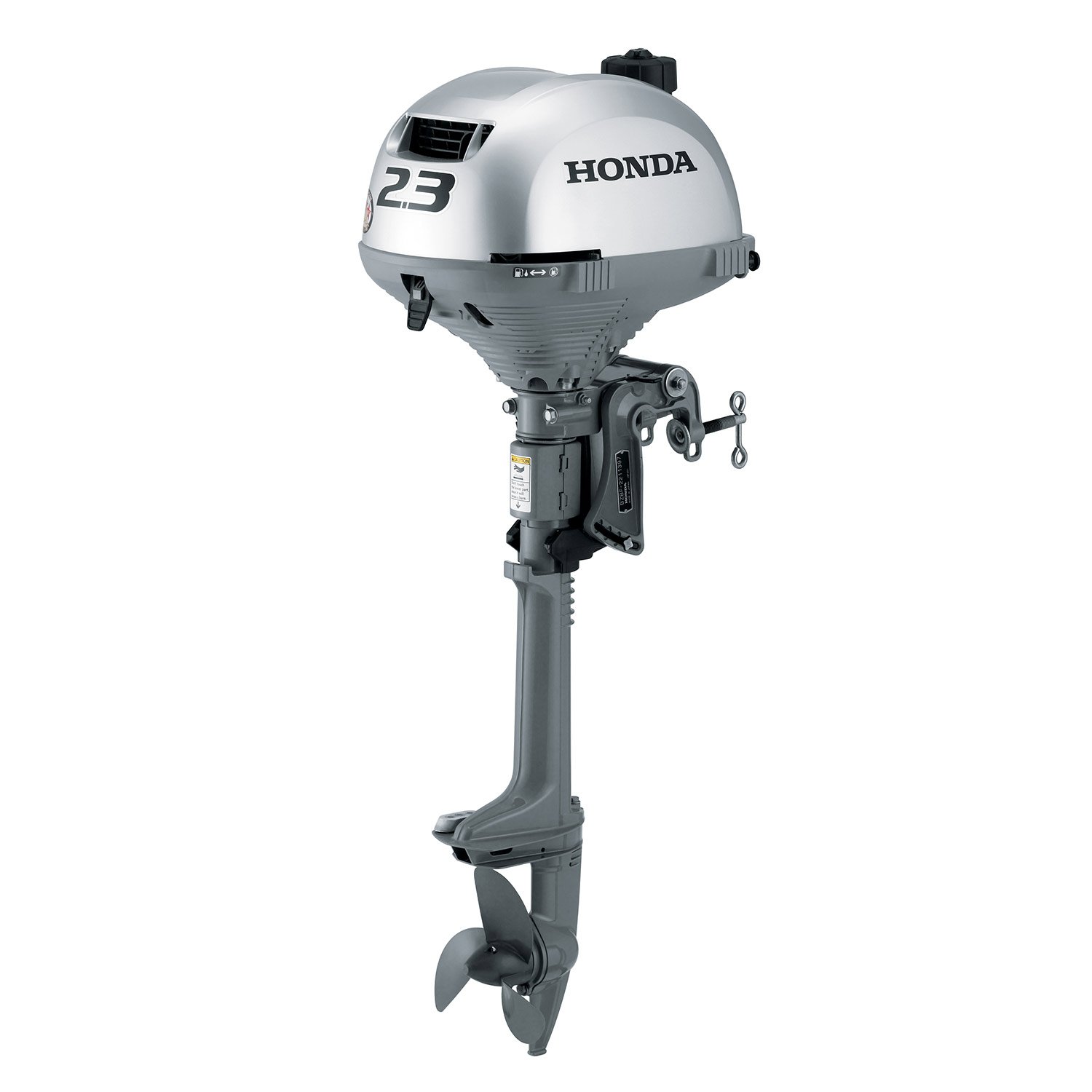
HONDA BF 2.3 Portable 4-Stroke Outboards
The best things come in small packages. And that’s especially true with Honda’s BF2.3, one of the world™s lightest four-stroke outboards. The BF2.3 is so light, it rivals many two-stroke 2HP engines and electric motors, without the battery! But just because it™s lightweight doesn™t mean Honda cut back on the power. The BF2.3 features 15% more power over its predecessor. Plus they added a 12% larger internal gas tank, which provides for about one hour of operation at wide open throttle. It™s a technologically advanced design that gives you power and performance “ without sacrificing portability.
Key Features
Lightweight Portability:
- Lightweight and compact
- The BF2.3 is incredibly light and easy to transport. Weighing less than 30 pounds, it’s the ideal engine for dinghys, car-toppers and other types of small boats.
- Easy to carry and install
- Front mounted carrying handle provides superior portability and ease of installation
Quiet & Smooth Performance:
- More power – without sacrificing portability
- With 15% more horsepower over its predecessor, this ultra light weight powerhouse produces surprising speed and maneuverability.
- Centrifugal clutch – better performance
- The centrifugal clutch maintains a smooth idle and when advanced, automatically engages the prop above idle speed. It’s like having a neutral position
Convenient Controls:
- Precise Throttle Control
- Twist grip throttle allows for precise throttle control. The throttle tensioner minimizes driver fatigue
- 360° swivel steering – added manueverability
- Provides excellent maneuverability in tight areas as well as full thrust in reverse (at 180°)
- Convenient fold down tiller
- The BF2.3’s tiller folds up or down for easy stowing
- Steering friction adjustment
- Allows you to adjust steering tension for ease in maneuverability
- Adjustable trim
- Four manual settings ensure proper trim angle for maximum performance
Easy Starting:
- The maintenance free transistor ignition offers high-energy output for quick and easy starts.
- Internal fuel tank – easier portability
- 12% more capacity over its predecessor, the BF2.3 now runs up to 60 minutes at full throttle on a tank of fuel. The internal tank facilitates easy removal and portability as a single unit
Easy Maintenance:
- The BF2.3 offers a convenient oil fill and drain. A carburetor drain screw allows quick and easy draining of the carburetor’s float bowl for extended storage periods
- Sheer and cotter pin keeper
- The self-contained keeper stores two extra sets of cotter and sheer pins close at hand, so you’ll be prepared if and when you need them.
- Dual lockable transom clamps
- Provides extra security when mounted to the transom
Legendary Reliability:
- True 5 Warranty – unmatched peace of mind
- Honda’s True 5 Warranty is the best in the business. This transferable, non-declining warranty is the same on the first day as it is on the last.
- Forced air cooled engine – no water pump worries
- The air-cooled block eliminates concern over clogged water pumps and debris being sucked into the powerhead, as well as reducing maintenance.
- 4-Front Corrosion Protection System – Fights the elements
- A patented, “Double Sealed” multi-layered paint process, sacrificial anodes, stainless steel technology, and waterproof connectors enhance corrosion protection
Description
Honda BF2.3 HP Portable 4 Stroke Outboard — Compact Power That Moves With You
A smarter way to power small boats starts here
Compact marine propulsion continues to evolve; however, few engines redefine expectations the way the Honda BF2.3 HP Portable 4 Stroke Outboard does. Designed for boaters who value reliability, efficiency, and effortless portability, this outboard delivers practical power without unnecessary complexity. Rather than forcing compromises between weight and performance, this model balances both with engineering discipline and real-world usability.
At the same time, modern boat owners increasingly demand engines that travel easily, start consistently, and operate quietly. Consequently, the Honda BF2.3 responds with a refined four-stroke design that suits tenders, inflatables, dinghies, sailboat auxiliaries, and small fishing craft. Moreover, its tool-free operation and integrated fuel system remove friction from ownership, especially for users who prioritize simplicity.
Why the Honda BF2.3 HP Portable 4 Stroke Outboard stands apart
Purpose-built for portability and confidence
Unlike larger outboards that require permanent mounting or complex storage solutions, the Honda BF2.3 was engineered to move as easily as the boat it powers. As a result, solo operators, families, and older boaters gain confidence when handling, transporting, and storing their engine.
Additionally, the internal fuel tank eliminates external hoses, while the air-cooled system removes the need for water pumps or flushing routines. Therefore, maintenance becomes more predictable and ownership costs remain controlled over time.
Key differentiation highlights:
-
Ultra-lightweight portable outboard design
-
Proven four-stroke reliability from Honda
-
Integrated fuel tank for simplified operation
-
Quiet, low-vibration performance for comfort
-
No mixing of oil and fuel required
Understanding buyer intent: who this outboard is built for
Designed for real users, not just specifications
Every marine engine solves a problem; however, the Honda BF2.3 solves several at once. For instance, tender owners often struggle with heavy motors that strain backs and complicate launching. In contrast, this outboard reduces physical effort without sacrificing thrust.
Similarly, anglers operating small boats need predictable low-speed control. Accordingly, the centrifugal clutch automatically engages at cruising RPM, ensuring smooth idle behavior near docks and fishing zones. Meanwhile, sailboat owners benefit from dependable auxiliary propulsion that starts after weeks of inactivity.
Ideal use cases include:
-
Inflatable boats and RIB tenders
-
Small aluminum fishing boats
-
Canoes and utility craft
-
Sailboat auxiliary propulsion
-
Emergency backup engines
Product overview: compact engineering with marine-grade durability
Power that feels effortless yet dependable
At its core, the Honda BF2.3 HP Portable 4 Stroke Outboard uses a 57cc four-stroke engine optimized for efficiency and longevity. Instead of relying on raw displacement, Honda focuses on torque delivery and smooth operation. Consequently, acceleration feels controlled rather than abrupt, even at low throttle inputs.
Furthermore, the air-cooled design removes many failure points associated with water-cooled systems. Since there is no impeller to wear out, downtime decreases while operational confidence increases. For boaters who value reliability in remote locations, this design choice matters.
Ease of use that lowers the learning curve
Simple controls encourage confident operation
First-time outboard users often feel overwhelmed by complex choke systems and fuel lines. Fortunately, the Honda BF2.3 removes those barriers. With a single-lever control layout, operators adjust throttle and steering intuitively. As a result, learning time shortens dramatically.
Additionally, the decompression mechanism reduces pull resistance during startup. Therefore, cold starts become easier, even for users with limited upper-body strength. Because the engine stabilizes quickly, docking maneuvers feel predictable rather than stressful.
User-friendly advantages:
-
Tool-free operation
-
Easy pull-start system
-
Intuitive throttle control
-
Minimal vibration at idle
-
Stable low-speed handling
Portability redefined for modern boaters
Lightweight construction without fragility
Portability only matters when durability follows. While some lightweight outboards sacrifice build quality, the Honda BF2.3 maintains structural integrity through high-grade materials and proven manufacturing standards. Consequently, the engine withstands frequent transport, storage, and seasonal use.
Moreover, the integrated carrying handle balances weight distribution. Thus, lifting and mounting feel controlled rather than awkward. For users who launch from beaches, docks, or ramps, this ergonomic design reduces fatigue and risk.
Portability benefits at a glance:
-
Compact footprint for easy storage
-
Balanced carry handle
-
No external fuel tank to manage
-
Ideal for car trunks and lockers
Fuel efficiency and environmental responsibility
Cleaner operation with lower running costs
Fuel efficiency remains a decisive factor for small-boat owners. Instead of consuming excess fuel at idle, the Honda BF2.3 optimizes combustion across the RPM range. Consequently, longer runtimes become possible using minimal fuel volume.
At the same time, four-stroke technology produces fewer emissions and less odor than traditional two-stroke alternatives. Therefore, users experience a cleaner environment onboard and at the shoreline.
Efficiency-focused highlights:
-
Four-stroke fuel economy
-
Reduced exhaust odor
-
No oil-fuel mixing
-
Lower long-term operating costs
Safety, stability, and peace of mind
Built-in features that protect both user and engine
Marine environments demand equipment that anticipates risk. Accordingly, the Honda BF2.3 includes safeguards that protect internal components during operation. For example, the centrifugal clutch prevents propeller spin at idle, reducing accidental movement near docks.
Additionally, the corrosion-resistant materials support longevity in saltwater and freshwater applications alike. As a result, owners experience consistent performance across seasons.
Safety-oriented design elements:
-
Neutral clutch engagement at idle
-
Stable steering response
-
Corrosion-resistant construction
-
Predictable throttle behavior
Technical Specifications, Performance Dynamics, and Operational Intelligence
Precision engineering that supports confident decisions
Selecting a small outboard often begins with specifications; however, meaningful performance depends on how those figures translate on the water. The Honda BF2.3 HP Portable 4 Stroke Outboard pairs efficient mechanical design with user-oriented engineering, ensuring that each component serves a clear operational purpose. Consequently, buyers gain clarity, not confusion, when evaluating suitability for their craft.Portable 4 Stroke Outboard
Core technical specifications explained clearly
Numbers that reflect real-world usability
Instead of inflating figures, Honda emphasizes balance across weight, power, and endurance. As a result, the BF2.3 delivers predictable propulsion while remaining easy to transport and operate.
Portable 4 Stroke Outboard Technical specifications overview:
-
Engine type: Four-stroke, single-cylinder
-
Displacement: 57 cc
-
Maximum output: 2.3 HP
-
Cooling system: Air-cooled
-
Ignition system: Transistorized ignition
-
Starting system: Manual recoil start with decompression
-
Fuel system: Integrated internal fuel tank
-
Fuel type: Unleaded gasoline
-
Oil system: Separate crankcase oil (no mixing required)
Each specification aligns with a practical benefit. For instance, the air-cooled system eliminates water pump failures, while the integrated fuel tank simplifies setup and teardown.
Power delivery and thrust characteristics
Controlled acceleration over raw force
Although rated at 2.3 horsepower, this engine emphasizes torque consistency rather than abrupt bursts. Therefore, boats accelerate smoothly, even when carrying gear or passengers. Small craft benefit especially, as sudden surges often compromise balance.
Additionally, the centrifugal clutch engages progressively as RPM increases. Because of this design, the propeller remains stationary at idle, improving control during docking and low-speed maneuvers.
Performance characteristics include:
-
Smooth throttle response
-
Predictable low-speed propulsion
-
Gradual clutch engagement
-
Stable mid-range cruising output
Propeller design and hydrodynamic efficiency
Optimized blade geometry for small hulls
The BF2.3 uses a carefully tuned propeller designed specifically for lightweight boats. Rather than prioritizing top-end speed, the blade profile focuses on thrust efficiency at low and moderate RPM ranges. Consequently, inflatables and dinghies maintain momentum without cavitation.Portable 4 Stroke Outboard
Moreover, the propeller works in tandem with the engine’s torque curve, ensuring energy transfers efficiently into forward motion. This synergy reduces fuel waste while enhancing maneuverability.
Propulsion advantages:
-
Reduced cavitation at low speeds
-
Efficient thrust for loaded tenders
-
Improved steering response
-
Minimal vibration transfer
Portable 4 Stroke Outboard Fuel efficiency and operating range
Longer runtimes with less refueling
Fuel efficiency remains central to the Honda BF2.3 HP Portable 4 Stroke Outboard’s appeal. Since the engine burns fuel only as needed, runtime extends without increasing tank size. As a result, users complete typical short trips without carrying additional fuel containers.Portable 4 Stroke Outboard
Furthermore, the internal tank design minimizes spillage risk during transport. Therefore, storage areas remain cleaner and safer.
Efficiency highlights:
-
Optimized combustion cycle
-
Reduced fuel consumption at idle
-
Clean exhaust output
-
Consistent performance across RPM ranges
Noise, vibration, and comfort management
A quieter boating experience
Noise fatigue affects enjoyment, particularly during fishing or extended low-speed travel. Honda addresses this concern through precision balancing and vibration isolation. Consequently, the BF2.3 operates quietly relative to its class.
Additionally, the air-cooled configuration avoids water turbulence noise often associated with pump-driven systems. As a result, onboard conversations remain comfortable, even during sustained operation.
Comfort-focused design elements:
-
Low-vibration engine mounts
-
Balanced internal components
-
Reduced mechanical noise
-
Smooth idle operation
Steering, control, and handling precision
Intuitive control that builds operator confidence
Steering responsiveness matters most in tight environments. The BF2.3’s tiller handle offers direct feedback, allowing fine directional adjustments. Therefore, docking maneuvers and shoreline approaches feel controlled rather than rushed.
Because the engine weight remains low, steering effort stays minimal. Consequently, longer operation sessions cause less fatigue, particularly for solo operators.
Handling benefits:
-
Precise tiller steering
-
Lightweight rotational mass
-
Predictable turning radius
-
Stable directional control
Reliability under varied conditions
Performance that remains consistent
Marine engines often face irregular usage patterns. Recognizing this, Honda engineered the BF2.3 to start reliably after periods of storage. Since the fuel system and ignition components resist degradation, startup consistency improves.Portable 4 Stroke Outboard
Moreover, the simplified cooling architecture reduces component wear. Therefore, operational reliability increases, even in sandy or debris-prone environments.
Portable 4 Stroke Outboard Reliability-focused features:
-
Fewer moving parts
-
Reduced maintenance intervals
-
Consistent cold-start behavior
-
Robust ignition system
Safety-driven mechanical intelligence
Thoughtful features that prevent common mishaps
The centrifugal clutch not only enhances handling but also improves safety. By preventing propeller movement at idle, accidental thrust near swimmers or docks becomes less likely.
Additionally, the stable engine mount minimizes unexpected shifts during operation. Consequently, both operator and passengers experience greater peace of mind.
Safety-related advantages:
-
Neutral idle propeller state
-
Predictable engagement threshold
-
Stable mounting interface
-
Controlled acceleration behavior
Real-World Applications, Portability Workflows, and Ownership Practicality
Where compact power delivers the most value
Specifications matter; however, real-world performance ultimately determines satisfaction. The Honda BF2.3 HP Portable 4 Stroke Outboard excels because its design aligns with how small boats are actually used. From short harbor transfers to relaxed fishing sessions, this engine adapts smoothly to varied conditions without demanding technical expertise.
Inflatable boats and RIB tenders
Efficient propulsion without overburdening the hull
Inflatable boats require balanced thrust to avoid excessive bow lift. Accordingly, the Honda BF2.3 provides steady propulsion that keeps hull attitude neutral. Since acceleration remains gradual, passengers experience stability rather than abrupt movement.
Additionally, the lightweight construction protects inflatable transoms from undue stress. Therefore, long-term structural integrity improves, especially for boats frequently launched from beaches or docks.
Benefits for inflatable users:
-
Reduced transom load
-
Smooth low-speed cruising
-
Quiet approach near moorings
-
Easy mounting and removal
Dinghies and small aluminum boats
Predictable handling for daily utility
Dinghies often serve as workhorses rather than recreational toys. Consequently, engines powering them must start reliably and maneuver precisely. The BF2.3 meets these demands through consistent throttle response and intuitive steering.
Moreover, its compact size preserves deck space. As a result, gear handling becomes easier, especially when transporting supplies or passengers.
Use-case advantages:
-
Reliable short-trip propulsion
-
Tight turning control near docks
-
Efficient operation with light loads
-
Minimal onboard footprint
Fishing applications and quiet-water operation
Supporting focus and comfort on the water
Anglers value silence and control. Therefore, the Honda BF2.3’s low-noise output enhances the fishing experience. Since vibration remains minimal, line control improves, especially during trolling or repositioning.
Furthermore, the neutral idle clutch prevents unintended movement. As a result, boat positioning stays consistent while casting or landing fish.
Fishing-focused benefits:
-
Quiet idle for reduced disturbance
-
Stable low-speed propulsion
-
Smooth throttle adjustments
-
Comfortable long-duration use
Sailboat auxiliary propulsion
Dependable backup when conditions change
Sailors rely on auxiliary engines during harbor entry, anchoring, or calm conditions. In these moments, predictability matters more than speed. Accordingly, the BF2.3 offers dependable thrust without overwhelming small sailboat tenders.
Since the engine stores easily onboard, it integrates well into limited spaces. Therefore, sailors maintain readiness without sacrificing deck organization.
Auxiliary advantages:
-
Consistent starts after storage
-
Compact stowage footprint
-
Low maintenance demands
-
Controlled maneuvering in tight marinas
Portability workflows: transport, storage, and handling
Designed for movement, not permanence
Portability extends beyond weight alone. Honda considered how users carry, store, and reinstall the engine repeatedly. Consequently, the BF2.3 includes an integrated handle positioned for balance.Portable 4 Stroke Outboard
Because the internal fuel tank removes hoses, setup time shortens dramatically. Thus, spontaneous trips become practical rather than cumbersome.Portable 4 Stroke Outboard
Portable 4 Stroke Outboard Typical portability workflow:
-
Lift using balanced carry handle
-
Transport without external fuel accessories
-
Mount directly onto transom
-
Start without priming or flushing
Storage flexibility for limited spaces
Practical solutions for boats, cars, and garages
Small craft owners often face storage constraints. Fortunately, the BF2.3’s compact dimensions allow storage in lockers, car trunks, or shelving units. Since no water remains in the system, corrosion risk decreases during off-season storage.
Additionally, the upright storage orientation prevents oil migration. Therefore, startup reliability improves after extended downtime.
Storage advantages:
-
Compact physical footprint
-
No residual water to drain
-
Clean storage without fuel spills
-
Seasonal storage readiness
Maintenance simplicity and service intervals
Ownership without complexity
Complex maintenance discourages use. Recognizing this, Honda engineered the BF2.3 with minimal service requirements. Oil changes remain straightforward, while the air-cooled design eliminates impeller inspections.
Moreover, the reduced component count lowers failure probability. Consequently, service costs remain manageable over the engine’s lifespan.
Maintenance highlights:
-
Simple oil service routine
-
No water pump maintenance
-
Accessible spark plug location
-
Long service intervals
Long-term durability and lifecycle value
Built to last beyond seasons
Marine environments accelerate wear; however, Honda’s corrosion-resistant materials mitigate this risk. As a result, the BF2.3 maintains performance consistency year after year.
Furthermore, the engine’s conservative tuning reduces internal stress. Therefore, long-term ownership delivers value beyond initial purchase price.
Durability-focused features:
-
Corrosion-resistant components
-
Robust mounting architecture
-
Stable internal tolerances
-
Proven manufacturing quality
Inclusive usability across experience levels
Designed for everyone onboard
Inclusive design ensures that strength, age, or experience does not limit operation. The BF2.3’s light pull-start and intuitive controls support a wide range of users. Consequently, families and mixed-experience crews operate confidently.
Because learning curves remain short, shared ownership becomes practical. Thus, more people enjoy time on the water.
Inclusivity benefits:
-
Low-effort starting
-
Simple control layout
-
Predictable behavior
-
Reduced physical strain
Competitive Positioning, Cost of Ownership, and Buyer Decision Support
Evaluating value beyond specifications
Purchase decisions rarely hinge on horsepower alone. Instead, long-term satisfaction depends on reliability, ownership cost, and day-to-day usability. The Honda BF2.3 HP Portable 4 Stroke Outboard competes effectively in its category by prioritizing total ownership value rather than headline metrics. Consequently, buyers experience fewer compromises after purchase.mercury outboard parts
Competitive positioning within the portable outboard segment
Designed for practicality, not overstatement
Many portable outboards emphasize either extreme lightness or maximum output. In contrast, the BF2.3 balances both attributes while maintaining mechanical simplicity. Because of this balance, it appeals to users who want dependable performance without constant tuning or troubleshooting.
Rather than relying on complex cooling systems or external fuel setups, Honda opts for an integrated, streamlined approach. Therefore, competitive differentiation emerges through usability rather than novelty.
Key positioning strengths:
-
Balanced power-to-weight ratio
-
Simplified air-cooled architecture
-
Integrated fuel system
-
Proven four-stroke engineering heritage
Performance comparison from a user perspective
What buyers notice on the water
When compared with similar-sized portable outboards, the BF2.3 distinguishes itself through smoothness and predictability. While some competitors deliver sharper acceleration, that behavior often introduces instability in lightweight hulls. Honda’s tuning strategy avoids that drawback.Portable 4 Stroke Outboard
Additionally, vibration levels remain lower during extended operation. As a result, comfort improves, especially for fishing or tender use.
Portable 4 Stroke Outboard User-noticeable differences:
-
Smoother throttle transitions
-
Lower perceived vibration
-
Quieter idle operation
-
More controlled low-speed maneuvering
Ownership cost analysis
Understanding total cost, not just purchase price
Initial pricing represents only one component of ownership. Over time, fuel consumption, maintenance frequency, and repair exposure influence real cost. Since the BF2.3 uses a four-stroke design with an air-cooled system, recurring expenses decrease.
Moreover, fewer serviceable components reduce labor requirements. Consequently, long-term operating costs remain predictable.
Cost-of-ownership advantages:
-
Lower fuel consumption
-
No oil-fuel mixing expense
-
Reduced service part replacement
-
Longer service intervals
Maintenance cost comparison logic
Fewer systems mean fewer failures
Water-cooled engines introduce impellers, intake screens, and flushing requirements. By contrast, the BF2.3 eliminates those elements entirely. Therefore, maintenance schedules simplify while downtime risk decreases.
Additionally, straightforward access to service points shortens routine maintenance time. As a result, owners either perform basic service themselves or incur minimal shop labor costs.
Maintenance-related savings:
-
No impeller replacement
-
No cooling passage blockages
-
Simplified seasonal storage
-
Reduced corrosion exposure
Reliability as a purchasing decision factor
Trust built through consistency
Portable outboards often serve as backup or mission-critical tools. Accordingly, reliability carries significant weight in buyer decisions. Honda’s conservative tuning philosophy emphasizes longevity rather than peak output. Consequently, internal stress remains low across operating conditions.mercruiser marine engine parts
Furthermore, consistent starting behavior enhances trust, especially after storage periods. This reliability profile strengthens resale value over time.
Reliability signals buyers recognize:
-
Consistent cold-start performance
-
Stable idle behavior
-
Minimal performance degradation
-
Long-term brand reputation
Addressing common buyer objections
Clarifying concerns before they become barriers
“Is 2.3 HP enough?”
For inflatables, dinghies, and tenders, controlled thrust matters more than raw horsepower. Therefore, the BF2.3 delivers sufficient propulsion for its intended applications.
“Why choose air-cooled?”
Air cooling removes failure points common in water-cooled systems. As a result, reliability improves, particularly in shallow or debris-filled waters.
“What about long-term value?”
Lower maintenance requirements and strong resale demand support long-term value retention.
Use-case-based buying recommendations
Matching the engine to the mission
Not every boater needs the same solution. The BF2.3 excels when portability, simplicity, and reliability rank highest.
Recommended for:
-
Tender and dinghy owners
-
Casual anglers
-
Sailboat auxiliary users
-
Seasonal boaters
-
Users prioritizing low maintenance
Less suitable for:
-
High-speed planing applications
-
Heavy multi-passenger loads
-
Large displacement hulls
Inclusive value proposition
Ownership confidence for diverse users
Inclusive design extends beyond ergonomics. Because the BF2.3 remains easy to operate, maintain, and store, it accommodates varied experience levels. Families, solo operators, and older boaters benefit equally.
Additionally, predictable behavior reduces anxiety for newer users. Thus, shared operation becomes practical and safe.
Inclusive advantages:
-
Low learning curve
-
Reduced physical strain
-
Predictable responses
-
Shared usability across crews


Reviews
There are no reviews yet.