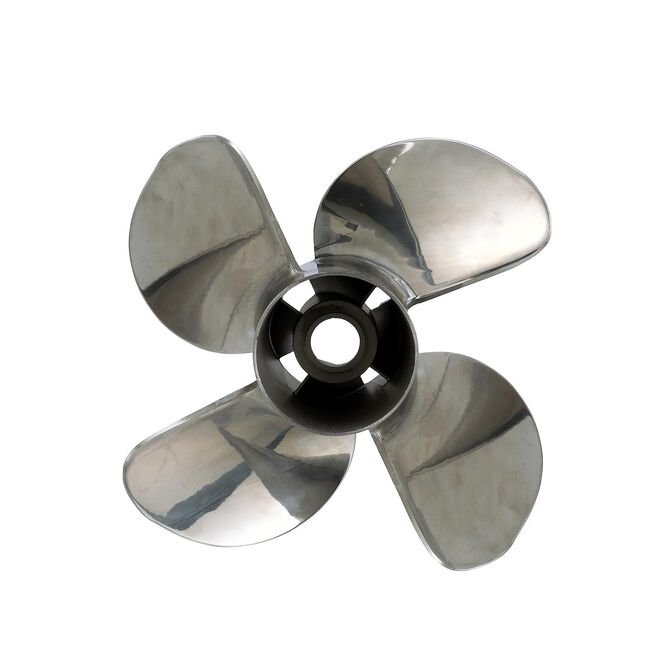
Quicksilver Q4 14.6″ Diameter X 21″ Pitch, 4-Blade Stainless Steel Propeller, Left Hand Rotation Model # 21440698 Mfg # 8M0103531
€620.00
QUICKSILVER Q4 14.6″ Diameter X 21″ Pitch, 4-Blade Stainless Steel Propeller, Left Hand Rotation
The Q3 is a revolutionary propeller that improves both acceleration and top speed on center consoles, high-horsepower pontoons, and sterndrive powered runabouts. The design consists of high rake angles and thin blades resulting in the Q3 being the highest performing 3-blade propeller in the Quicksilver line-up.
Key Features
- 14.6″ diameter, 21″ pitch, left-hand rotation
- Stainless steel propeller
- Highest performing 3-blade propeller in the Quicksilver line-up
- Revolutionary prop that improves both acceleration and top speed
Description
Quicksilver Q4 14.6 Diameter × 21 Pitch 4-Blade Stainless Steel Propeller – Left Hand Rotation
Precision Propulsion Designed for Confident Performance
In marine propulsion, performance is never accidental. Instead, results are achieved through careful engineering, material integrity, and intelligent hydrodynamic design. With that principle firmly in place, the Quicksilver Q4 14.6 Diameter × 21 Pitch 4-Blade Stainless Steel Propeller with Left Hand Rotation stands as a purpose-built solution for boaters who demand predictable handling, reliable thrust, and long-term durability across a wide range of operating conditions.
Rather than settling for compromise, this propeller has been developed to support confident acceleration, smoother cruising, and enhanced control at both low and high speeds. As a result, it appeals to recreational boaters, performance enthusiasts, and professionals alike—each seeking a propeller that complements their vessel while elevating the overall on-water experience.
Because propulsion affects every moment on the water, selecting the right propeller becomes a strategic decision rather than a simple accessory purchase. For that reason, the Quicksilver Q4 series has been engineered with balance, strength, and efficiency at its core, ensuring consistent performance season after season.
Why Propeller Design Matters More Than Ever
Modern boats are heavier, more powerful, and more versatile than ever before. Consequently, propeller design has evolved to meet these demands through improved blade geometry, advanced materials, and refined pitch control. In this context, a 4-blade stainless steel propeller offers clear advantages over traditional 3-blade or aluminum alternatives.
By distributing load across four precisely shaped blades, the Quicksilver Q4 enhances grip in the water. As a result, ventilation is reduced, acceleration is improved, and handling remains predictable—even during sharp turns or rough water operation. Additionally, stainless steel construction allows for thinner yet stronger blades, which translates into better hydrodynamic efficiency and improved fuel utilization.
Equally important, left hand rotation propellers are essential for twin-engine and counter-rotating setups, where balance, torque management, and directional stability play a critical role. When properly matched, this configuration contributes to smoother steering response and reduced operator fatigue over extended use.
Introducing the Quicksilver Q4 Series Advantage
Within the Quicksilver propeller lineup, the Q4 series occupies a distinct position. It has been designed to bridge the gap between everyday usability and performance-driven engineering. Instead of focusing on a single operating scenario, the Q4 propellers support a broad spectrum of boating activities, including cruising, towing, offshore runs, and load-heavy applications.
Because versatility is often the deciding factor for modern boat owners, the Q4 design emphasizes adaptability without sacrificing performance. Therefore, whether the vessel is lightly loaded for a leisure cruise or carrying passengers and gear for extended outings, consistent thrust and control remain available.
This balance is achieved through:
-
Optimized blade rake for lift and stability
-
Carefully calculated pitch for efficient power transfer
-
Reinforced hub architecture for long-term reliability
Each of these elements contributes to a propulsion system that works with the engine rather than against it.
Product Specifications at a Glance
To support informed decision-making, the core specifications of the Quicksilver Q4 14.6 × 21 Left Hand Rotation Propeller are outlined below.
🔹 Key Technical Details
-
Diameter: 14.6 inches
-
Pitch: 21 inches
-
Blade Count: 4-Blade Configuration
-
Material: Premium Stainless Steel
-
Rotation: Left Hand (Counter-Rotating)
-
Application: Outboard and sterndrive engines (model-specific compatibility applies)
These specifications have been selected to support balanced performance across acceleration, cruising efficiency, and top-end control.
Built for Stainless Steel Strength and Longevity
Material choice directly impacts both performance and lifecycle cost. For this reason, stainless steel remains the preferred option for serious boaters. Unlike aluminum, stainless steel resists flex under load, ensuring that blade geometry remains consistent even at higher RPMs or under heavy acceleration.
As a result:
-
Engine power is transferred more efficiently
-
Cavitation risk is reduced
-
Long-term performance consistency is preserved
Furthermore, stainless steel offers superior corrosion resistance, making it well-suited for both freshwater and saltwater environments. When properly maintained, a stainless steel propeller such as the Quicksilver Q4 delivers years of dependable service while retaining its performance characteristics.
4-Blade Configuration: Control Without Compromise
Although 3-blade propellers are common, a 4-blade design offers meaningful advantages in real-world conditions. Specifically, the additional blade increases surface area, which enhances water grip and minimizes slip.
Because of this design choice, operators experience:
-
Faster and more controlled hole-shot
-
Improved mid-range stability
-
Smoother handling in turns
-
Reduced vibration at cruising speeds
In practical terms, this means more confidence at the helm, particularly when operating in variable water conditions or when carrying uneven loads.
Optimized for Left Hand Rotation Applications
Left hand rotation propellers play a crucial role in balanced propulsion systems. In twin-engine configurations, counter-rotating props offset torque forces, thereby improving straight-line tracking and steering precision.
When integrated correctly, the Quicksilver Q4 Left Hand Rotation propeller:
-
Enhances directional stability
-
Reduces steering correction effort
-
Supports smoother docking and low-speed maneuvering
This makes it especially valuable for boaters who prioritize control, predictability, and ease of operation.
Designed for Inclusive Performance Needs
Boating is enjoyed by individuals and families, professionals and enthusiasts, newcomers and experienced operators alike. Recognizing this diversity, the Quicksilver Q4 propeller has been designed with inclusive performance in mind.
Rather than catering exclusively to one user profile, it supports:
-
Confident handling for less experienced operators
-
Responsive feedback for seasoned boaters
-
Comfortable operation for extended trips
Because everyone deserves a smooth and enjoyable experience on the water, this propeller emphasizes reliability, predictability, and ease of use alongside performance.
Ideal Use Scenarios
The versatility of the Quicksilver Q4 14.6 × 21 propeller allows it to perform effectively across a wide range of boating activities.
✔ Common Applications
-
Recreational cruising
-
Offshore and coastal boating
-
Family outings with variable passenger loads
-
Performance-oriented leisure boating
-
Twin-engine setups requiring left hand rotation
This adaptability ensures that the propeller continues to deliver value even as boating needs evolve.
Setting the Foundation for Performance-Driven Ownership
Selecting a propeller is not merely about specifications; it is about aligning equipment with expectations. With its stainless steel construction, 4-blade efficiency, and left hand rotation design, the Quicksilver Q4 14.6 × 21 propeller establishes a strong foundation for reliable and enjoyable boating.
In the next section, we will explore detailed performance characteristics, including acceleration behavior, cruising efficiency, fuel optimization, and load management—providing deeper insight into how this propeller performs under real-world conditions.
Performance Dynamics and On-Water Behavior
Translating Engineering into Real-World Results
While specifications define capability, performance is ultimately measured on the water. For that reason, the Quicksilver Q4 14.6 Diameter × 21 Pitch 4-Blade Stainless Steel Propeller with Left Hand Rotation has been engineered to convert theoretical advantages into tangible, repeatable outcomes across diverse operating conditions.
Rather than emphasizing peak numbers alone, this propeller focuses on balanced performance. Consequently, acceleration, mid-range efficiency, and handling consistency are all addressed simultaneously. This holistic approach ensures that users experience meaningful benefits not only during wide-open throttle operation but throughout every phase of a typical boating session.
Acceleration and Hole-Shot Performance
Faster Planing with Controlled Power Delivery
Acceleration represents one of the most immediately noticeable performance factors. With four blades distributing thrust more evenly, the Quicksilver Q4 delivers a smoother and more assertive hole-shot compared to many traditional propeller designs.
Because blade surface area is increased, water grip improves at lower speeds. As a result, power transfer becomes more efficient during initial throttle application. This characteristic proves especially valuable when launching with passengers, towing water sports equipment, or navigating choppy conditions where maintaining momentum is critical.
Performance benefits include:
-
Reduced bow rise during acceleration
-
Faster transition onto plane
-
More predictable throttle response
-
Improved control under load
Importantly, this enhanced acceleration does not come at the expense of smoothness. Instead, power is delivered progressively, allowing operators of varying experience levels to maintain confidence and comfort.
Mid-Range Cruising Efficiency
Stability Where Boats Spend Most of Their Time
Although top speed often captures attention, most vessels operate within the mid-range RPM band for the majority of their runtime. Recognizing this reality, the Quicksilver Q4 has been optimized to perform efficiently and smoothly during cruising operation.
Through carefully tuned pitch geometry, the 21-inch pitch allows engines to maintain optimal RPM without excessive strain. Consequently, fuel burn remains controlled, vibration is minimized, and noise levels are reduced—contributing to a more enjoyable onboard environment.
Because stainless steel resists flex, blade shape remains stable under sustained load. Therefore, cruising efficiency remains consistent even during long runs or variable sea states.
Mid-range advantages include:
-
Stable RPM at cruising speeds
-
Improved fuel efficiency compared to flex-prone materials
-
Reduced operator fatigue
-
Enhanced passenger comfort
This balance makes the propeller particularly well-suited for extended outings, coastal cruising, and family-oriented boating activities.
Handling, Steering, and Control Characteristics
Confident Maneuverability in All Conditions
Handling performance extends beyond speed alone. Steering response, directional stability, and low-speed control all contribute to overall safety and enjoyment. In this regard, the Quicksilver Q4 excels by maintaining continuous water engagement through its four-blade configuration.
Because each blade remains engaged with the water more consistently, steering input translates into immediate response. As a result, the vessel feels more planted during turns, even when encountering wake turbulence or uneven chop.
Furthermore, the left hand rotation design supports torque balance in counter-rotating setups. When paired correctly, steering corrections are reduced, and straight-line tracking improves.
Handling improvements include:
-
Enhanced grip during tight turns
-
Reduced propeller slip
-
Improved tracking at cruising speeds
-
Greater control during docking and low-speed maneuvers
These attributes benefit both seasoned operators and those still developing their skills.
Performance Under Load and Variable Conditions
Designed to Perform When Conditions Change
Boating conditions are rarely static. Passenger count, fuel load, weather, and sea state can all change within a single outing. For this reason, adaptability becomes a defining performance metric.
The Quicksilver Q4’s stainless steel construction and blade geometry allow it to maintain thrust consistency even as load increases. Consequently, performance degradation under heavier conditions is minimized.
Whether the vessel is carrying additional passengers, towing equipment, or navigating rougher water, thrust delivery remains reliable. This consistency enhances safety while reducing the need for frequent throttle adjustments.
Load-handling strengths include:
-
Sustained acceleration with added weight
-
Stable RPM behavior under stress
-
Reduced ventilation in choppy water
-
Predictable response during trim adjustments
This adaptability reinforces the propeller’s role as a long-term solution rather than a single-scenario component.
Top-End Performance and RPM Management
Balanced Speed Without Sacrificing Control
Although 4-blade propellers are often associated with mid-range strength, the Quicksilver Q4 has been engineered to preserve competitive top-end performance. Through optimized pitch and rake angles, drag is managed efficiently without compromising blade strength.
As a result, engines are able to reach recommended operating RPM ranges when properly matched. This ensures both performance integrity and engine longevity.
Rather than chasing maximum speed at the expense of control, the Q4 prioritizes usable performance. Consequently, operators benefit from speed that feels stable, controllable, and repeatable.
Vibration Reduction and Ride Quality
Smoother Operation for Extended Enjoyment
Vibration not only impacts comfort but can also accelerate component wear over time. By maintaining consistent blade engagement and minimizing flex, the Quicksilver Q4 reduces vibration across a broad RPM range.
This smoother operation contributes to:
-
Quieter cruising
-
Reduced mechanical stress
-
Improved onboard comfort
-
Greater confidence at the helm
For families, groups, and professionals alike, this refinement enhances the overall boating experience.
Performance Summary: What This Means for You
Taken together, the performance characteristics of the Quicksilver Q4 14.6 × 21 Left Hand Rotation propeller deliver a well-rounded, confidence-inspiring experience.
✔ Performance Highlights
-
Strong, controlled acceleration
-
Efficient and stable cruising behavior
-
Predictable handling and steering response
-
Reliable performance under load
-
Smooth, low-vibration operation
These benefits reinforce the propeller’s suitability for a wide range of boating styles and user expectations.
Compatibility, Fitment, and Installation Considerations
Ensuring the Right Match for Optimal Performance
Even the most advanced propeller can only perform as intended when compatibility is properly addressed. For that reason, selecting the Quicksilver Q4 14.6 Diameter × 21 Pitch 4-Blade Stainless Steel Propeller with Left Hand Rotation requires careful consideration of engine specifications, drivetrain configuration, and operational goals.
Rather than relying on guesswork, informed fitment ensures that performance gains are realized while protecting engine health. Consequently, understanding compatibility criteria becomes a critical step in the purchasing process.
Engine Compatibility Overview
Designed to Integrate with Common Marine Power Systems
The Quicksilver Q4 propeller line has been engineered to support a wide range of modern outboard and sterndrive engines. Because Quicksilver designs its propellers with OEM-level precision, compatibility aligns closely with popular marine engine platforms when correct hub systems are used.
Although exact fitment depends on the selected hub kit, this propeller is commonly paired with:
-
Mid-to-high horsepower outboard engines
-
Sterndrive applications requiring stainless steel strength
-
Twin-engine configurations using counter-rotation
By supporting modular hub systems, the propeller can be adapted to multiple engine brands while maintaining secure torque transfer and vibration control.
Understanding Left Hand Rotation Requirements
Why Rotation Direction Matters
Rotation direction plays a significant role in propulsion balance and handling behavior. A left hand rotation propeller is engineered to rotate counterclockwise when viewed from behind the boat. This configuration is essential in specific setups and should never be substituted incorrectly.
Left hand rotation is typically required for:
-
Twin-engine boats using counter-rotating props
-
Specific sterndrive applications
-
Boats designed for torque-balancing propulsion
When correctly installed, counter-rotation improves straight-line tracking and reduces steering correction. As a result, vessel control becomes more intuitive, especially at cruising speeds.
Because improper rotation selection can negatively impact handling and drivetrain components, confirming rotation direction before purchase is strongly recommended.
Diameter and Pitch: Why 14.6 × 21 Matters
Balancing Thrust, Speed, and Efficiency
Diameter and pitch work together to define how a propeller interacts with the water. In this configuration, a 14.6-inch diameter provides sufficient blade surface area to maintain water grip, while a 21-inch pitch supports efficient forward travel per revolution.
This balance is particularly effective for:
-
Boats requiring strong mid-range performance
-
Engines operating within recommended RPM bands
-
Applications where load may vary between outings
Because pitch directly influences engine RPM, selecting the correct pitch ensures that the engine neither over-revs nor labors under excessive load. Consequently, engine longevity and fuel efficiency are both preserved.
Hub System Compatibility and Adaptability
Modular Design for Flexible Fitment
Rather than using a fixed hub, the Quicksilver Q4 propeller is designed to work with interchangeable hub kits. This modular approach allows the propeller to be adapted across multiple engine platforms while maintaining proper alignment and shock absorption.
Key advantages of a modular hub system include:
-
Reduced drivetrain shock during gear shifts
-
Improved spline engagement
-
Simplified replacement or reconfiguration
-
Enhanced vibration dampening
Because the hub acts as the interface between engine and propeller, selecting the correct hub kit is just as important as choosing the propeller itself.
Installation Considerations and Best Practices
Straightforward Installation with Professional Results
When installed correctly, the Quicksilver Q4 propeller integrates seamlessly into existing propulsion systems. Although professional installation is always recommended for optimal assurance, experienced boat owners may perform installation by following manufacturer guidelines.
Best practices include:
-
Verifying correct hub kit installation
-
Ensuring proper torque on retaining hardware
-
Inspecting thrust washers and spacers
-
Confirming rotation direction before launch
After installation, a controlled test run should be conducted to confirm RPM range, vibration levels, and handling response.
Trim Interaction and Setup Optimization
Maximizing Performance Through Proper Adjustment
Once installed, propeller performance is further refined through trim adjustments. Because the Q4 maintains consistent water grip, trim response tends to be more predictable than with lower-blade-count propellers.
As trim is adjusted:
-
Bow lift becomes smoother
-
RPM changes remain controlled
-
Handling response stays balanced
This predictability allows operators to fine-tune performance without sudden loss of grip or ventilation.
Common Fitment Scenarios and Use Cases
Where This Propeller Excels
Thanks to its balanced specifications and adaptable design, the Quicksilver Q4 14.6 × 21 Left Hand Rotation propeller is commonly selected for:
-
Twin-engine boats requiring counter-rotation
-
Offshore and coastal vessels carrying variable loads
-
Family boats prioritizing smooth handling
-
Operators upgrading from aluminum to stainless steel
This versatility reduces the likelihood of future replacement as boating needs evolve.
Reducing Risk Through Informed Selection
Propeller selection directly affects safety, efficiency, and enjoyment. By ensuring proper compatibility, confirming rotation direction, and following installation best practices, buyers can confidently unlock the full potential of the Quicksilver Q4 propeller.
Rather than treating fitment as an afterthought, this approach positions the propeller as a long-term performance investment.
Durability, Materials, and Long-Term Ownership Value
Engineered for Strength You Can Rely On
Durability is not a secondary benefit in marine environments; it is a foundational requirement. With exposure to torque load, water resistance, salinity, and variable operating conditions, a propeller must maintain structural integrity over time. For this reason, the Quicksilver Q4 14.6 Diameter × 21 Pitch 4-Blade Stainless Steel Propeller with Left Hand Rotation has been manufactured to withstand real-world stress without compromising performance consistency.
Rather than relying on thickness alone, strength is achieved through material selection, blade geometry, and precision manufacturing. Consequently, the propeller delivers dependable operation across seasons, usage patterns, and water types.
Stainless Steel as a Performance Material
Why Stainless Steel Outperforms Alternatives
Material choice directly influences how a propeller behaves under load. Stainless steel is selected for the Quicksilver Q4 because it offers a superior strength-to-weight ratio compared to aluminum and composite alternatives.
Because stainless steel resists flexing at high RPM, blade shape remains true during operation. As a result, thrust delivery stays consistent, and hydrodynamic efficiency is preserved even during aggressive acceleration or sustained cruising.
Material advantages include:
-
Minimal blade deformation under torque
-
Higher resistance to impact damage
-
Improved efficiency through thinner blade profiles
-
Longer service life in demanding conditions
These characteristics ensure that performance on day one closely mirrors performance after extended use.
Corrosion Resistance in Freshwater and Saltwater
Built to Withstand Harsh Marine Environments
Exposure to water introduces corrosion risk, particularly in saltwater applications. To address this, the Quicksilver Q4 propeller utilizes corrosion-resistant stainless steel alloys designed for marine use.
As a result:
-
Surface integrity is maintained over time
-
Pitting and material fatigue are minimized
-
Performance degradation due to corrosion is reduced
When paired with standard anode protection and routine maintenance, this propeller remains structurally sound and visually presentable across long ownership cycles.
Structural Integrity Under Repeated Load
Consistency That Protects Your Engine
A propeller that flexes excessively places inconsistent load on the drivetrain. Over time, this can contribute to premature wear on engine components. Because the Quicksilver Q4 maintains its geometry under stress, load distribution remains predictable.
Consequently:
-
Engine RPM behavior stays within expected ranges
-
Gearcase stress is reduced
-
Power transfer remains efficient
This consistency supports both performance reliability and engine longevity.
Resistance to Minor Impacts and Debris
Practical Protection in Real-World Conditions
Although no propeller is immune to damage, stainless steel offers significantly improved resistance to minor impacts with debris, vegetation, or submerged objects. Instead of bending easily, stainless steel blades are more likely to maintain usable form.
This resilience:
-
Reduces the frequency of repairs
-
Lowers long-term maintenance costs
-
Preserves balance and smooth operation
For boaters operating in unfamiliar or debris-prone waters, this added protection contributes to peace of mind.
Maintenance Expectations and Ownership Simplicity
Designed for Low-Stress Ownership
Despite its advanced construction, the Quicksilver Q4 does not require complex maintenance routines. Routine inspection, cleaning, and hub system checks are typically sufficient to preserve optimal performance.
Recommended best practices include:
-
Periodic inspection for surface damage
-
Rinsing after saltwater use
-
Monitoring hub condition
-
Verifying hardware torque during seasonal checks
By following these simple steps, owners can expect consistent operation and long service life.
Long-Term Value Compared to Lower-Cost Alternatives
An Investment That Pays Back Over Time
While stainless steel propellers represent a higher initial investment than aluminum options, long-term value is realized through durability, efficiency, and reduced replacement frequency.
Over time, owners benefit from:
-
Fewer performance losses due to deformation
-
Lower likelihood of repeated replacement
-
Improved fuel efficiency consistency
-
Sustained resale value of the vessel
Because performance remains stable, the propeller continues to deliver returns well beyond the initial purchase.
Designed for Inclusive, Long-Term Use
Durability is not solely about materials; it is also about usability. The Quicksilver Q4 has been designed for a wide range of users, from occasional recreational boaters to frequent operators.
Because reliability reduces stress and uncertainty, this propeller supports inclusive boating experiences by making performance predictable and maintenance manageable for everyone.


Reviews
There are no reviews yet.