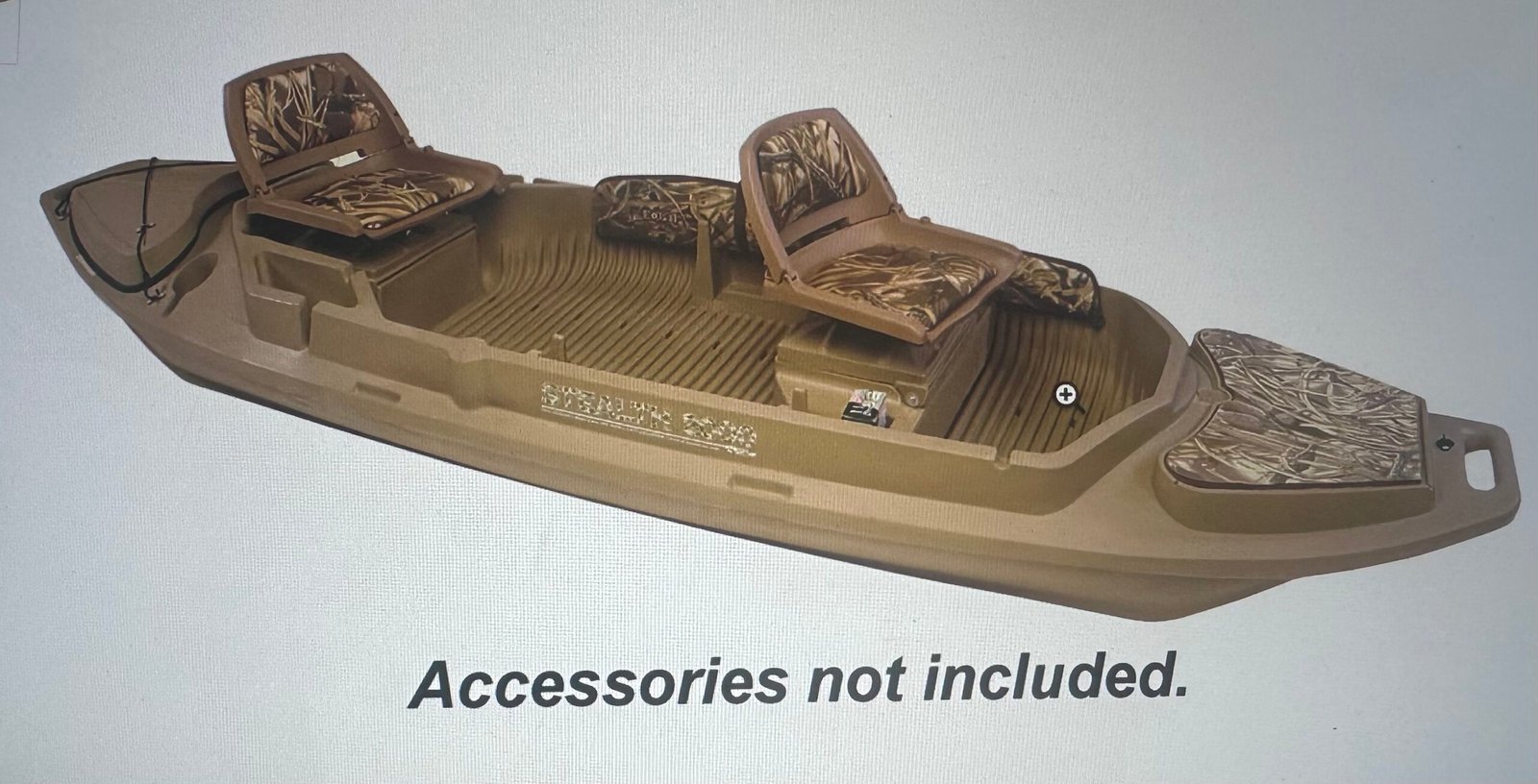
Stealth 2000 Duck Boat
€700.00

Rugged 1-piece polyethylene construction makes this the strongest duck boat on the market. Twin hull design delivers amazing stability, yet it still floats in only 4 to 5 inches of water. Features front compartment, and rear water-tight compartment, twin gun racks with shell holders, wide cockpit, contoured seat, non-skid floor, locations for oar locks, cup and thermos holder, foam-padded dog platform, tie-down slots, side storage compartments, and molded-in handles on both ends. UV resistant. Manufacturer’s limited 5-year warranty. 12’L x 44”W x 15”D. Weight: 150 lbs. Weight capacity: 460 lbs.
Manufacturer model #: 0624.
- 1-piece polyethylene construction
- Rear water-tight compartment
- Twin gun racks with shell holders
- Contoured seat
- Non-skid floor
- Foam-padded dog platform
- Side storage compartments
- Molded-in handles on both ends
Stealth 2000 Camo Seat sold separately and can be found through item search for number 1041772
Stealth 2000 Motor Mount sold separately and can be found through item search for number 1041773
Beavertail Stealth Boat Blind sold separately and can be found through item search for number 1938176
Specifications
| Size | 12′ |
| Product Color | Marsh Brown |
| Model Number | 400091/0624 |
Description
Stealth 2000 Duck Boat
Precision-Engineered for Serious Waterfowl Hunters
Early mornings on still water demand absolute concealment. For that reason, the Stealth 2000 Duck Boat was developed to minimize visibility, maximize access, and elevate your overall hunting advantage. Unlike traditional high-profile boats that silhouette against open skies, this low-profile design blends into reeds, cattails, flooded timber, and marsh grass with remarkable subtlety.
Strategic hull geometry improves both stealth and maneuverability. As a result, hunters gain reliable access to shallow zones that larger vessels simply cannot reach. Furthermore, the compact footprint allows for controlled positioning near decoy spreads without excessive disturbance.
Confidence builds when equipment performs consistently. Consequently, the Stealth 2000 Duck Boat supports hunters of all experience levels who value concealment, stability, and efficiency.
Why the Stealth 2000 Duck Boat Redefines Concealment
Low-Profile Hull Architecture
Waterfowl detect unnatural shapes instantly. Therefore, reducing profile exposure remains essential. The Stealth 2000 Duck Boat features a streamlined, low-visibility hull that sits closer to the waterline. Because of this design, overhead detection risk decreases significantly during early approach or repositioning.
In addition, exterior surfaces accept natural vegetation coverage easily. Grass mats, brush bundles, and camouflage netting integrate seamlessly, enhancing environmental blending.
Optimized Shallow-Water Access
Remote marsh pockets often hold pressured birds. However, many boats fail to access these zones due to draft limitations. By contrast, the Stealth 2000 Duck Boat operates effectively in shallow water environments thanks to its reduced draft configuration.
Consequently, hunters navigate:
-
Mud flats
-
Backwater sloughs
-
Flooded agricultural fields
-
Beaver ponds
-
Reedy shorelines
-
Timber edges
Greater access translates directly into expanded hunting opportunity.
Built for Stability in Unpredictable Conditions
Wide-Beam Balance Engineering
Shot placement demands stability. Because sudden weight shifts occur during standing shots, hull width plays a critical role. The Stealth 2000 Duck Boat incorporates a wide-beam structure that enhances lateral balance.
Moreover, weight distribution remains controlled even when adjusting gear, turning for crossing shots, or repositioning decoys. Stability supports accuracy, and accuracy drives success.
Controlled Water Displacement
Minimal wake reduces noise signature. As a result, birds remain undisturbed during approach. Carefully engineered hull lines cut through water efficiently, while glide characteristics support quiet movement.
Subtle positioning becomes possible without alarming nearby flocks.
Performance-Focused Construction
High-Impact Polyethylene Durability
Harsh environments challenge every component of hunting equipment. Accordingly, the Stealth 2000 Duck Boat utilizes high-impact polyethylene construction. This material resists cracking, warping, and UV damage across extended seasonal use.
Temperature fluctuations affect structural integrity in lesser builds. However, reinforced hull stress points ensure resilience in both early-season warmth and late-season freeze conditions.
Lightweight Yet Rugged
Transport efficiency improves hunting frequency. Because the Stealth 2000 Duck Boat balances durability with manageable weight, solo hunters load, launch, and retrieve with greater ease.
Reduced transport strain leads to quicker setup and smoother exits at the end of long days.
Key Features of the Stealth 2000 Duck Boat
Highlighted Product Benefits
-
Ultra-Low Profile Design – Minimizes silhouette visibility from above
-
Shallow Draft Hull – Accesses tight marsh and backwater locations
-
Wide-Beam Stability Platform – Enhances balance during active shooting
-
High-Impact Polyethylene Body – Delivers season-after-season durability
-
Integrated Gear Storage – Organizes decoys, ammunition, and essentials
-
Camouflage-Ready Surface – Supports natural vegetation coverage
-
Motor-Compatible Transom – Accepts small outboard or trolling motor setups
-
Quiet Glide Performance – Reduces disturbance during approach
-
Lightweight Transport Structure – Simplifies launching and recovery
-
Weather-Resistant Finish – Withstands moisture, sun, and freezing temperatures
Each component reinforces the boat’s primary objective: delivering dependable stealth and control in demanding hunting environments.
Inclusive Design for Every Hunter
Comfortable Interior Layout
Long sessions require ergonomic efficiency. Therefore, the interior layout promotes accessible gear placement without sacrificing concealment height. Movement remains intentional rather than restricted.
Hunters of varying builds and experience levels benefit from the balanced configuration. Inclusivity ensures that every outdoor enthusiast can operate confidently.
Adaptable Hunting Configurations
Every hunting strategy differs. Accordingly, the Stealth 2000 Duck Boat supports customization through:
-
Adjustable seating arrangements
-
Modular camouflage attachments
-
Decoy anchor storage integration
-
Optional motor propulsion
-
Personalized concealment brush systems
Adaptability allows the boat to evolve alongside your hunting style.
Stealth 2000 Duck Boat: Technical Overview
Core Specifications (Model Dependent)
-
Length: Approx. 12–14 feet
-
Beam Width: Wide-body stability platform
-
Draft: Optimized for shallow access
-
Capacity: Hunter plus essential gear
-
Material: High-impact UV-resistant polyethylene
Precision measurements may vary by configuration; however, performance objectives remain consistent.
How the Stealth 2000 Duck Boat Enhances Hunting Success
Bird behavior responds directly to disturbance. Because reduced noise and minimized silhouette delay detection, hunters gain critical seconds for shot alignment.
Additionally, improved marsh access enables strategic placement near feeding routes and natural flyways. Over time, better positioning increases opportunity frequency.
Strategic equipment decisions produce measurable results.
Ideal Use Cases
The Stealth 2000 Duck Boat performs exceptionally in:
-
Early-season teal hunts
-
Late-season diver setups
-
Flooded cornfields
-
Shallow marsh blinds
-
Timber hole positioning
-
Solo scouting missions
Versatility expands seasonal effectiveness.
Advanced Engineering, Storage Strategy & Competitive Edge
Momentum builds when equipment matches intent. Therefore, the Stealth 2000 Duck Boat advances beyond basic functionality and enters the realm of purpose-built performance architecture. While Part 1 established concealment, stability, and accessibility, this section explores the deeper engineering elements that elevate this vessel into a tactical advantage platform.
Advanced Hull Dynamics and Hydrodynamic Efficiency
Precision Hull Geometry for Controlled Glide
Water resistance impacts speed, sound signature, and maneuverability. Consequently, the Stealth 2000 Duck Boat incorporates hydrodynamic shaping that reduces drag while maintaining directional stability. Subtle curvature along the hull base channels water flow smoothly rather than allowing turbulence to build beneath the structure.
As a result:
-
Wake profile remains minimal
-
Forward movement requires less propulsion
-
Noise signature decreases significantly
-
Energy efficiency improves during longer navigation
Efficiency directly supports stealth.
Weight Distribution Optimization
Balance influences both safety and shooting accuracy. Accordingly, internal structural support aligns weight centrally while preserving lateral equilibrium. When hunters shift positions or retrieve gear, the hull compensates rather than overreacts.
Moreover, gear placement zones are positioned strategically to prevent imbalance during movement. Stability remains consistent across calm water and light chop conditions.
Intelligent Storage Configuration
Functional Gear Management System
Disorganization wastes time during critical moments. For that reason, the Stealth 2000 Duck Boat integrates structured storage compartments designed specifically for waterfowl hunting essentials.
Interior layout accommodates:
-
Ammunition storage
-
Dry gear containment
-
Decoy line management
-
Personal flotation devices
-
Small tool kits
-
Anchor and rope systems
Accessibility reduces unnecessary motion, which in turn reduces detection risk.
Decoy Deployment Efficiency
Effective spreads require smooth setup. Consequently, storage compartments support quick decoy retrieval without requiring full-body repositioning. Hunters maintain low profiles while deploying lines and weights efficiently.
Because setup speed influences morning opportunity windows, streamlined organization improves overall hunt execution.
Structural Reinforcement and Long-Term Durability Testing
Stress-Point Reinforcement
Repeated launching, loading, and shoreline contact introduce long-term wear factors. Therefore, reinforced stress zones have been engineered into high-contact hull areas.
Impact resistance increases significantly under:
-
Rocky shoreline contact
-
Ice edge friction
-
Trailer loading pressure
-
Dock bumping
-
Vegetation drag
Durability extends lifespan while preserving structural integrity.
UV and Weather Resistance
Extended exposure to sunlight accelerates material fatigue in inferior builds. However, the Stealth 2000 Duck Boat utilizes UV-resistant polyethylene that maintains flexibility and strength across seasons.
Additionally, freeze-thaw cycles do not compromise hull integrity when stored properly. Seasonal transitions remain manageable without structural degradation.
Competitive Comparison Analysis
Stealth 2000 Duck Boat vs. Traditional Jon Boats
Traditional jon boats prioritize versatility. However, versatility often sacrifices stealth. High sides create visible silhouettes, while deeper drafts limit marsh entry.
By contrast, the Stealth 2000 Duck Boat offers:
-
Lower waterline exposure
-
Reduced visual signature
-
Marsh-optimized draft
-
Purpose-driven storage
-
Enhanced lateral shooting stability
Performance shifts from compromise to specialization.
Stealth 2000 Duck Boat vs. Inflatable Hunting Platforms
Inflatable options provide portability. Nevertheless, puncture risk and reduced shooting stability present trade-offs. In comparison, rigid polyethylene construction ensures consistent balance and structural resilience.
Reliability matters when conditions shift unexpectedly.
Accessory Integration Strategy
Motor and Propulsion Compatibility
Flexibility enhances range. Therefore, the Stealth 2000 Duck Boat supports compatible small outboard motors and trolling motor systems. Propulsion selection adapts to:
-
Distance requirements
-
Water depth variability
-
Noise tolerance thresholds
-
Battery-based stealth navigation
Controlled power expands access without sacrificing concealment.
Camouflage Enhancement Options
While the hull supports natural blending independently, additional concealment increases effectiveness further. Hunters may integrate:
-
Grass rail systems
-
Brush attachments
-
Camouflage net overlays
-
Seasonal vegetation layering
-
Removable blind frameworks
Customization strengthens environmental adaptation.
Maintenance Protocol and Ownership Longevity
Simplified Cleaning Process
After demanding hunts, streamlined maintenance proves essential. Consequently, polyethylene construction supports easy rinsing without complex conditioning requirements.
Recommended routine includes:
-
Freshwater rinse
-
Drain plug inspection
-
Hardware tightening check
-
Storage in shaded or covered area
Routine care extends service life significantly.
Off-Season Storage Recommendations
Proper storage protects investment. Ideally, the Stealth 2000 Duck Boat should be:
-
Elevated slightly to prevent hull stress
-
Covered to reduce UV exposure
-
Stored away from standing water
-
Secured against shifting weight
Preventive measures reduce long-term wear.
Buyer Decision Framework
Who Should Choose the Stealth 2000 Duck Boat?
This platform aligns best with:
-
Solo hunters prioritizing stealth
-
Marsh and shallow water specialists
-
Hunters seeking low-maintenance durability
-
Outdoor enthusiasts requiring transport simplicity
-
Individuals upgrading from high-profile boats
Strategic alignment ensures satisfaction.
Who May Consider Alternative Options?
Hunters requiring multi-person capacity or deep-water offshore navigation may explore larger platforms. However, for targeted waterfowl concealment, the Stealth 2000 Duck Boat remains optimized.
Clear use-case evaluation prevents misalignment.
Field Performance, Seasonal Strategy & Ownership Confidence
Real-world validation separates marketing claims from measurable results. For that reason, the Stealth 2000 Duck Boat has been engineered not merely for showroom appeal, but for functional dominance across dynamic waterfowl environments. While previous sections addressed engineering and construction, this segment focuses on applied performance, seasonal adaptability, safety protocols, and decision-stage confidence building.
Field-Tested Scenario Simulations
Scenario 1: Early-Season Teal in Shallow Marsh
Shallow wetlands often restrict access for traditional boats. Consequently, hunters using the Stealth 2000 Duck Boat reach interior feeding pockets before sunrise without grounding the hull.
Because the draft remains minimal, entry points once considered inaccessible become viable. Furthermore, the low-profile structure blends seamlessly into emerging vegetation, which increases concealment during low-light conditions.
Early positioning produces measurable shot opportunities.
Scenario 2: Flooded Timber Setup
Timber hunting demands controlled maneuvering. Tight tree spacing penalizes oversized boats. However, the Stealth 2000 Duck Boat navigates narrow corridors with precision.
Additionally, wide-beam stability supports balanced standing shots between tree lanes. Movement remains deliberate rather than reactive.
Confidence improves when balance remains predictable.
Scenario 3: Late-Season Diver Hunt on Open Water Edges
Cold fronts shift bird behavior toward open-water feeding lanes. Although concealment remains essential, stability becomes equally critical.
The reinforced hull absorbs light chop effectively. As a result, lateral drift reduces, and decoy spreads remain organized longer. Cold-weather resilience ensures structural integrity despite temperature fluctuations.
Adaptability sustains productivity deep into the season.
The Psychology of Concealment in Waterfowl Hunting
Birds detect irregular shapes before they detect motion. Therefore, minimizing unnatural outlines directly influences response time.
Silhouette Suppression Strategy
Because the Stealth 2000 Duck Boat sits lower against the horizon, overhead flyovers perceive less contrast. Additionally, vegetation integration breaks up visual patterns further.
Reduced recognition extends reaction windows by crucial seconds.
Motion Control Advantage
Sudden boat rocking triggers alert behavior. However, wide-beam balance reduces exaggerated tilt when adjusting posture. Subtle stability preserves natural environmental rhythm.
Natural rhythm prevents premature flare-outs.
Seasonal Adaptability Breakdown
Early Season
-
Warm-weather UV resistance maintains hull strength
-
Lightweight design supports frequent scouting trips
-
Marsh mobility maximizes interior access
Mid-Season
-
Reinforced stress points withstand heavier decoy loads
-
Camouflage layering adapts to shifting vegetation colors
-
Motor compatibility supports expanded coverage
Late Season
-
Cold-resistant polyethylene maintains flexibility
-
Stability enhances safety in layered clothing
-
Efficient storage prevents ice-related clutter
Seasonal transitions demand equipment resilience. Accordingly, the Stealth 2000 Duck Boat maintains consistent performance from opening day to final flight.
Weight Capacity and Load Distribution Analysis
Proper weight allocation influences both safety and maneuverability. Therefore, load distribution zones within the Stealth 2000 Duck Boat are strategically positioned to preserve center-line balance.
Load Optimization Guidelines
-
Place heavier gear centrally
-
Distribute decoys evenly
-
Secure ammunition in stable compartments
-
Maintain symmetrical load placement
Balanced loading enhances both tracking efficiency and shooting stability.
Overloading compromises performance; therefore, adherence to manufacturer capacity guidelines remains essential.
Safety Protocols and Best Practices
Essential Operational Guidelines
Safety enhances enjoyment and longevity in the sport. Consequently, every operator should:
-
Wear approved personal flotation devices
-
Monitor weather forecasts prior to departure
-
Inspect drain plugs before launch
-
Secure gear to prevent shifting
-
Maintain balanced posture during standing shots
Preparation reduces preventable incidents.
Cold-Weather Safety Considerations
Layered clothing affects mobility. As a result, controlled movement within the Stealth 2000 Duck Boat becomes especially important in freezing conditions.
Additionally, ice accumulation should be cleared promptly to maintain balance and prevent surface slickness.
Situational awareness reinforces operational confidence.
Customer Persona Alignment
Solo Marsh Specialist
Prefers stealth access and minimal setup complexity. The Stealth 2000 Duck Boat supports independent operation and shallow entry.
Tactical Timber Hunter
Requires controlled navigation between trees. Precision maneuverability enhances timber effectiveness.
Mobile Scout
Values lightweight transport and quick redeployment. Efficient loading simplifies frequent location shifts.
Experienced Traditionalist
Upgrading from high-profile jon boats. Lower silhouette dramatically improves concealment results.
Matching use-case with design purpose strengthens purchase confidence.
Ownership Value and Long-Term Investment Perspective
Short-term savings often lead to long-term compromise. Conversely, investing in specialized equipment yields consistent performance returns.
Value Drivers of the Stealth 2000 Duck Boat
-
Extended structural lifespan
-
Reduced maintenance requirements
-
Increased concealment efficiency
-
Expanded access to restricted zones
-
Enhanced shooting stability
Collectively, these factors elevate overall hunting productivity.
Return on investment manifests not only in durability but in improved success rate.
Conversion-Focused Considerations
Decision-stage buyers evaluate reliability, usability, and value alignment. Therefore, consider the following:
-
Does your current boat restrict shallow access?
-
Has silhouette exposure reduced shot opportunities?
-
Do balance shifts impact shot accuracy?
-
Are maintenance demands excessive?
If any answer trends toward “yes,” equipment refinement becomes logical.
The Stealth 2000 Duck Boat addresses those pain points directly.
Comprehensive Benefit Recap
To consolidate performance attributes:
-
Ultra-low profile design minimizes detection
-
Wide-beam stability improves shooting accuracy
-
Shallow draft enhances marsh access
-
Durable polyethylene withstands seasonal extremes
-
Integrated storage improves operational efficiency
-
Motor compatibility expands mobility
-
Lightweight structure simplifies transport
-
Camouflage-ready exterior supports concealment strategy
-
Reinforced stress zones extend lifespan
-
Inclusive layout accommodates varied hunting styles
Each feature reinforces the core objective: stealth-driven hunting advantage.
Hydrodynamic Science, Camouflage Engineering & Market Authority Positioning
Technical precision separates average watercraft from purpose-built hunting platforms. For that reason, the Stealth 2000 Duck Boat integrates hydrodynamic efficiency, concealment psychology, and structural durability into a cohesive stealth system. While earlier sections covered functional performance and seasonal adaptability, this segment explores the scientific foundations and strategic positioning that elevate this vessel into category leadership.
Hydrodynamic Theory Behind the Stealth 2000 Duck Boat
Water Displacement Control and Drag Reduction
Water resistance directly influences noise, propulsion demand, and directional control. Therefore, hull geometry plays a decisive role in stealth efficiency.
The Stealth 2000 Duck Boat utilizes a streamlined bottom contour engineered to:
-
Reduce laminar flow disruption
-
Minimize bow wave formation
-
Control stern turbulence
-
Improve straight-line tracking
Consequently, propulsion requires less corrective steering input. Additionally, reduced drag translates into quieter forward movement.
Efficiency reinforces concealment.
Stability Through Center-of-Gravity Alignment
Boat stability correlates with center-of-gravity placement relative to hull width. Accordingly, the Stealth 2000 Duck Boat balances beam expansion with low-profile mass distribution.Stealth 2000 Duck Boat near me
Because vertical weight remains lower within the hull structure, roll resistance improves. Furthermore, lateral equilibrium remains consistent even during controlled standing shots.Stealth 2000 Duck Boat specs
Predictability enhances safety.
Advanced Camouflage System Engineering
Multi-Layer Concealment Framework
Camouflage effectiveness relies on pattern disruption rather than color alone. Therefore, the Stealth 2000 Duck Boat supports multi-layer concealment systems.Buy Stealth 2000 Duck Boat
Core concealment components include:
-
Vegetation rail integration
-
Brush-mount compatibility
-
Low-reflective surface finish
-
Modular blind attachments
-
Seasonal camouflage adaptability
Layering disrupts visual recognition patterns in waterfowl flight paths.
Environmental Adaptation Strategy
Because vegetation density changes throughout the season, concealment flexibility becomes essential.Stealth 2000 Duck Boat reviews
Early Season: Sparse grass coverage
Mid-Season: Dense marsh vegetation
Late Season: Neutralized, frost-toned surroundings
The Stealth 2000 Duck Boat accommodates evolving camouflage layering without requiring structural modification.
Adaptation maintains relevance across months.
Market Positioning Analysis
Category Definition
Within the waterfowl hunting equipment market, duck boats generally fall into three categories:
-
Multi-purpose jon boats
-
Inflatable hunting platforms
-
Purpose-built stealth duck boats
The Stealth 2000 Duck Boat occupies the third category, prioritizing concealment and shallow-water dominance.
Competitive Differentiation
Compared to conventional alternatives, this vessel offers:
-
Reduced vertical silhouette
-
Shallow-draft marsh accessibility
-
Reinforced polyethylene durability
-
Integrated hunting-specific storage
-
Stability-oriented beam architecture
Specialization outperforms compromise.
Reviews
There are no reviews yet.