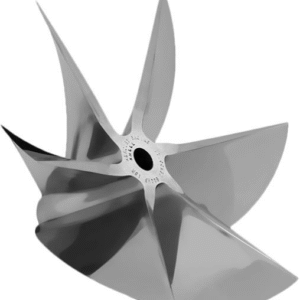
Mercury Racing CNC Cleaver Pro Finished 5 Blade Sterndrive Propeller Performance on the water is not achieved by chance. It is engineered through precision, validated through testing, and experienced through control. The Mercury Racing CNC Cleaver Pro Finished 5 Blade Sterndrive Propeller has been developed for boaters who expect measurable results rather than marketing promises. Every design decision reflects a singular objective: converting engine power into efficient, stable, and repeatable propulsion at speed.Mercury Racing CNC Cleaver Backed by the engineering heritage of Mercury Racing, this propeller is positioned at the intersection of advanced manufacturing and real-world marine performance. High-output sterndrive systems demand accuracy at the blade level, consistency across production, and durability under load. Those requirements are addressed through CNC machining, a refined cleaver profile, and a professionally finished surface that reduces hydrodynamic resistance. Rather than serving as a generic replacement component, this propeller functions as a performance upgrade. Speed, handling, and responsiveness are improved simultaneously, ensuring that no single performance metric is enhanced at the expense of another.Mercury Racing CNC Cleaver Designed for Precision-Driven Marine Performance Marine propulsion efficiency is influenced by blade geometry, balance, surface finish, and load distribution. Each of these variables has been optimized within this propeller to deliver predictable results across a wide range of operating conditions.Mercury Racing CNC Cleaver CNC Machining for Exacting Tolerances Computer Numerical Control (CNC) machining ensures that each blade is cut to precise specifications. Variability associated with casting or manual finishing processes is eliminated. As a result, blade pitch, rake, and cup remain consistent from unit to unit. This level of precision produces tangible advantages: Hydrodynamic efficiency is improved Harmonic vibration is reduced Engine-to-propeller power transfer becomes more efficient Because tighter tolerances are maintained, performance remains consistent even during sustained high-speed operation.Mercury Racing CNC Cleaver Five-Blade Cleaver Geometry Explained The cleaver-style blade profile has long been associated with high-speed sterndrive and surface-piercing applications. In this configuration, thrust is optimized at elevated RPM ranges while maintaining directional stability. Why a Five-Blade Configuration Matters Increasing blade count alters how torque is distributed through the water. With five blades engaged, thrust loads are spread more evenly. This design choice enhances grip, particularly during aggressive acceleration and high-speed cornering.Mercury Racing CNC Cleaver Operational benefits include: Faster planing characteristics Improved mid-range control Enhanced stability in rough or aerated water Instead of relying on raw engine output alone, this propeller uses blade efficiency to maintain momentum and control. Pro Finished Surface for Reduced Hydrodynamic Drag Surface finish directly impacts water flow across the blade face. Micro-imperfections create turbulence, which increases drag and reduces efficiency. This propeller is professionally finished to minimize those imperfections.Mercury Racing CNC Cleaver Performance Impact of a Pro Finish A smoother surface promotes cleaner water separation and more consistent pressure distribution. Consequently, top-end speed potential is increased while engine strain is reduced.Mercury Racing CNC Cleaver Key advantages include: Higher achievable speeds at wide-open throttle More efficient cruising RPM ranges Reduced long-term blade fatigue The finish is not cosmetic. It is functional, contributing directly to performance outcomes. Engineered for High-Horsepower Sterndrive Systems High-performance sterndrives operate under significant mechanical stress. Torque spikes during acceleration and sustained RPM at speed place heavy demands on propulsion components. This propeller has been engineered to handle those conditions reliably. Mercury Racing CNC Cleaver Ideal Application Scenarios This propeller is particularly well-suited for: Offshore performance boats High-speed recreational sterndrive vessels Competitive and semi-competitive marine environments Boats requiring enhanced control at elevated speeds By optimizing blade loading, drivetrain stress is managed more effectively, supporting both performance and longevity.Mercury Racing CNC Cleaver How Hydrodynamics Shape Real-World Propeller Performance Water is an unforgiving medium. Small inefficiencies at the blade level compound rapidly as speed increases. For this reason, the hydrodynamic profile of the Mercury Racing CNC Cleaver Pro Finished 5 Blade Sterndrive Propeller has been engineered with a performance-first mindset. Every curve, edge, and angle exists to control water flow, manage pressure differentials, and convert rotational energy into forward motion with minimal loss. Rather than relying on generalized design assumptions, this propeller leverages proven hydrodynamic principles to ensure predictable performance across a broad RPM range. Acceleration, lift, and stability are addressed simultaneously, ensuring balanced behavior under varying load and sea conditions.Mercury Racing CNC Cleaver Cleaver Blade Design: Managing Lift and Thrust at Speed Cleaver-style propellers differ fundamentally from round-ear or semi-cleaver designs. Lift is generated primarily at the trailing edge rather than across the entire blade surface. This characteristic is particularly advantageous for high-speed sterndrive applications. Trailing-Edge Lift Explained By concentrating lift toward the rear of the blade: Bow lift is reduced Stern lift is increased Hull attitude becomes flatter at speed As a result, drag is minimized while directional stability is enhanced. This flatter running angle allows boats to maintain speed more efficiently, especially in offshore or choppy conditions. Blade Geometry Optimization Through CNC Machining Blade geometry consistency is essential when hydrodynamic balance is required. CNC machining allows pitch progression, rake angle, and blade thickness to be controlled precisely from hub to tip. Key Geometric Elements Refined The following elements have been carefully engineered: Progressive pitch: Maintains thrust as RPM increases Optimized rake: Improves water retention at high speeds Balanced blade thickness: Enhances strength without adding unnecessary drag Because these parameters remain consistent across all five blades, oscillation and imbalance are minimized. Consequently, smoother power delivery is achieved throughout the operating range. Five-Blade Load Distribution and Torque Management Torque management becomes increasingly important as engine output rises. With fewer blades, torque loads concentrate on limited surface area. In contrast, a five-blade configuration distributes those forces more evenly. Hydrodynamic Benefits of Increased Blade Count By spreading load across five blades: Cavitation risk is reduced Water grip remains consistent during acceleration Steering torque fluctuations are minimized This distribution improves control during rapid throttle changes, which is critical for performance boating environments. Cavitation and Ventilation Control at High RPM Cavitation and ventilation are common challenges in high-speed sterndrive applications. Both phenomena disrupt water flow and reduce effective thrust. How This Propeller Mitigates Flow Disruption…